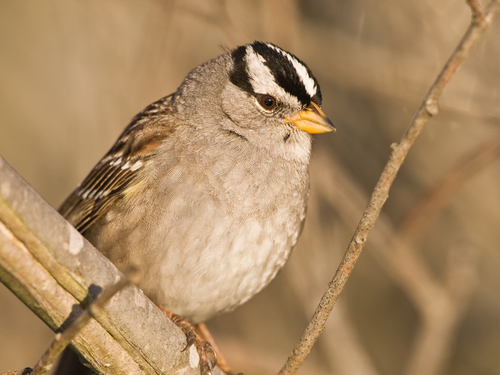
White-crowned Sparrow
Zonotrichia leucophrys
With its dapper black-and-white crown and sweet, whistling song, this elegant sparrow is a favorite of backyard birdwatchers. Watch for its unique 'double-scratch' dance as it hunts for seeds among the fallen leaves.
Quick Identification
Size
Length: 5.9–7.1 in (15–18 cm) | Wingspan: 8.3–9.4 in (21–24 cm) | Weight: 0.9–1.0 oz (25–28 g)
Colors
Distinctive black and white horizontal stripes on the crown; grey face, neck, and breast; brown-streaked back and wings; pale yellow or pinkish-orange bill.
Key Features
- Bold black and white striped crown
- Clear grey breast without spotting
- Pale, conical bill in shades of yellow or pink
- Long, slightly notched tail
When You’ll See Them
Sightings on EverydayEarth
Jun 27, 2026
A White-crowned Sparrow is seen on the feeder tray, hopping forward and turning its head to reveal its distinctive striped crown before quickly hopping out of view.
Jun 12, 2026
An adult White-crowned Sparrow lands on the edge of the bird feeder tray. It hops across the surface, foraging for seeds and occasionally looking directly into the camera lens before moving closer to the edge.
Jun 4, 2026
A White-crowned Sparrow perches on the edge of the white feeder tray, busily foraging through the grains and sunflower seeds.
Jun 1, 2026
A White-crowned Sparrow lands on the rim of the feeder tray. It spends several seconds peering down and pecking at the seeds before hopping off and flying away.
May 25, 2026
A Blue Jay lands directly in front of the camera, vigorously searching through the sunflower seeds before departing. Shortly after, a White-crowned Sparrow hops onto the feeder tray to forage.
May 25, 2026
A White-crowned Sparrow lands on the edge of the bird feeder tray, its distinctive black and white head stripes clearly visible. It briefly searches through the mix of seeds and cracked corn before hopping out of view.
Behavior
The White-crowned Sparrow is a charismatic and bold visitor to backyard stations, known for its remarkably crisp plumage and its "double-scratch" foraging technique. You’ll often see them hopping along the ground, jumping forward and then kicking back with both feet simultaneously to uncover seeds and insects hidden beneath leaf litter. They are social birds, frequently seen in small flocks during the winter months, often mixing with other sparrow species like Dark-eyed Juncos.
While they are ground-dwellers by nature, they are also famous for their haunting, melodic whistling song, which they often sing from a low perch in a shrub or fence line. In many parts of North America, their arrival marks the change of seasons, as they migrate in large numbers. Despite their small size, they are quite hardy and can be surprisingly bold around humans, often being the first to return to a feeder after a disturbance.
EverydayEarth exclusive
Camera Tips
To capture the best footage of White-crowned Sparrows, place your AI camera low to the ground—ideally between 6 and 12 inches high. Since these birds are ground foragers, a camera mounted on a traditional high bird feeder pole will often miss the best action. Set your camera near the base of a dense shrub or a brush pile, as these birds rarely venture more than a few feet away from a quick escape route. Clear a small 2-foot patch of ground to serve as your "stage" and sprinkle a mix of white proso millet and sunflower hearts to keep them in the frame longer.
The "double-scratch" movement is a fantastic behavior to capture on video. To get high-quality clips, use a camera with a high frame rate (at least 30fps) to avoid motion blur during their quick hops. If your camera has adjustable focal lengths, aim for a wide-angle view that includes both the ground and the lower branches of a nearby bush, as they love to hop up and "scout" the area before diving back into the seeds. Morning light is your best friend here; the low sun will illuminate the white stripes on their head without creating the harsh shadows that can happen at midday.
During the winter, providing a heated ground-level birdbath can be a massive draw. White-crowned Sparrows are frequent bathers, and the movement of water is often a stronger lure than food alone. Position your camera to face the water source from the north or south to avoid direct lens flare. If you are using a trigger-based camera, set a short reset interval (5-10 seconds) because these birds often travel in small groups; once the first one arrives, the rest of the flock usually follows within seconds, providing excellent multi-bird footage.
Similar Species
Species that look similar or are commonly confused with White-crowned Sparrow.
White-throated Sparrow
Features a crisp white throat patch and yellow 'eyebrows' (lores) which the White-crowned Sparrow lacks.
Golden-crowned Sparrow
Has a duller crown with a central golden-yellow stripe instead of white, and lacks the bright white side-stripes.
Chipping Sparrow
Much smaller with a solid rusty-red cap during the breeding season and a distinct black line through the eye.
Frequently Asked Questions
Record White-crowned Sparrow at your habitat
Connect a camera to start building your own species record — AI identifies every visitor automatically.