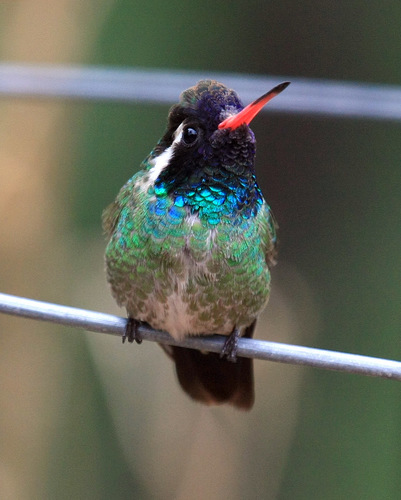
White-eared Hummingbird
Basilinna leucotis
A bold mountain gem with a striking white mask and a vibrant red bill. The White-eared Hummingbird brings a flash of violet and emerald to high-altitude gardens.
Quick Identification
Size
9–10 cm (3.5–4 in) long; wingspan of approx. 13 cm (5 in); 3–4 g (0.11–0.14 oz)
Colors
Iridescent emerald green body; male has violet-blue crown and throat with a bright red bill tipped in black; female has white underparts with green spotting; both feature a bold white ear stripe.
Key Features
- Bold, thick white stripe extending behind the eye
- Bright red bill with a dark tip
- Iridescent violet-blue face and throat (males)
- Frequent metallic 'tink' call
When You’ll See Them
Behavior
The White-eared Hummingbird is a spunky and spirited visitor, often described as more aggressive and territorial than other hummingbird species. Despite their small size, they are fiercely protective of their food sources, frequently engaging in high-speed aerial dogfights to drive away larger competitors. Their presence is usually announced by a distinctive, metallic 'tink-tink-tink' call that sounds like two small pebbles being struck together.
In social settings, they are solitary and rarely share feeders. They tend to hover with a very high-frequency wingbeat, resulting in a low hum, and move in sharp, jerky patterns. While they are primarily mountain-dwellers, they are remarkably bold around humans, often hovering just a few feet away to inspect a new feeder or a brightly colored piece of garden equipment.
EverydayEarth exclusive
Camera Tips
To capture the stunning iridescence of the White-eared Hummingbird, position your AI camera approximately 12 to 18 inches away from a nectar feeder. Use a 45-degree side angle slightly below the feeder's ports; this specific angle is best for highlighting the male's violet throat and the bright red base of the bill. Avoid placing the camera directly facing the sun, as backlighting will wash out the metallic feathers and make the bird look like a dark silhouette.
Because these birds are incredibly fast, set your camera to its highest possible frame rate or 'Action' mode. If your camera has a 'Pre-Roll' feature, enable it—this allows the device to save the few seconds of footage leading up to the motion trigger, ensuring you catch the bird as it arrives rather than as it's flying away. High-sensitivity settings are a must for these small, fast-moving targets to ensure the motion sensor triggers the moment they enter the frame.
White-eared Hummingbirds are very sensitive to their surroundings and prefer feeders located near 'perching cover' like a thicket or pine tree. Placing your camera near a feeder that is tucked into a quiet, semi-shaded corner of the yard will yield more frequent visits. If you are using a trail camera, mount it at chest height (4-5 feet) and ensure there are no stray leaves or branches in the immediate foreground that might cause false triggers on windy days.
Similar Species
Species that look similar or are commonly confused with White-eared Hummingbird.
Frequently Asked Questions
Record White-eared Hummingbird at your habitat
Connect a camera to start building your own species record — AI identifies every visitor automatically.