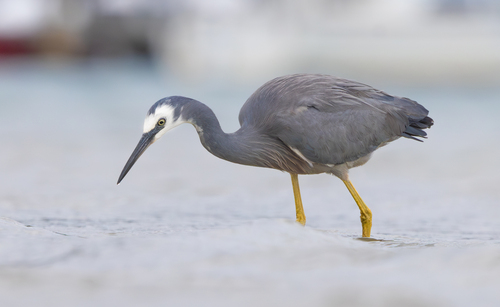
White-faced Heron
Egretta novaehollandiae
With its striking white 'mask' and elegant blue-grey plumage, the White-faced Heron is the most versatile and common large wading bird in Australasian backyards. Watch as this patient hunter stalks your lawn or pond with professional precision.
Quick Identification
Size
Length: 60–70 cm (24–28 in); Wingspan: 100–110 cm (39–43 in); Weight: 550–600 g (1.2–1.3 lbs)
Colors
Uniform blue-grey body plumage with a distinct white face and throat; yellow to dull olive-green legs; dark grey flight feathers.
Key Features
- Distinct white face and throat extending behind the eye
- Uniform blue-grey body plumage
- Long, slender yellow or olive-green legs
- Slightly hunched posture when standing or stalking
When You’ll See Them
Behavior
The White-faced Heron is a graceful, versatile hunter often seen patrolling shorelines or stalking through tall grass. Unlike many other herons that stick strictly to deep water, this species is remarkably comfortable in suburban environments, frequently visiting garden ponds, swimming pools, and even flooded lawns after heavy rain. They are primarily solitary foragers but may gather in loose groups where food is abundant, such as during a plague of grasshoppers or when a pond is drying out.
When hunting, they move with a slow, deliberate gait, often pausing mid-step to scan for movement. If disturbed, they take flight with slow, powerful wingbeats, often emitting a harsh, guttural 'graak' sound. They are relatively tolerant of human presence compared to other wading birds, making them a delightful regular for backyard observers who have provided the right habitat features.
EverydayEarth exclusive
Camera Tips
To capture the elegant stride of a White-faced Heron, place your camera near the edge of a water feature, such as a garden pond or a low-lying area that collects water after rain. Unlike many smaller garden birds, herons have a tall profile, so mount your camera about 2 to 3 feet off the ground. Angling the camera level or slightly upward will ensure you capture the entire bird rather than just its legs. If you have a large lawn, look for 'worming' behavior—herons often hunt for invertebrates in the grass early in the morning, making these open spaces great secondary camera locations.
Since these birds are sensitive to sudden movements but curious about water, a shallow birdbath placed on the ground is an excellent lure. Ensure your camera's trigger speed is set to its fastest setting; while the heron moves slowly when stalking, its neck strike is lightning fast, and you’ll want to capture that action clearly. High-resolution video mode is particularly rewarding with this species, as it captures the subtle 'foot-stirring' technique they use to flush out prey from the mud or grass.
Lighting is key for showcasing their subtle blue-grey plumage. Try to position the camera with the sun at its back to avoid silhouetting the bird, which can wash out the distinctive white face markings. During the breeding season (usually spring), they may become more active and vocal. If you have a tall tree nearby, they might even roost or nest there, so consider an upward-angled camera if you spot them frequenting specific high branches. Avoid using bright artificial flashes if possible, as it may spook them; instead, rely on the natural early morning or late afternoon light when they are most active.
Similar Species
Species that look similar or are commonly confused with White-faced Heron.
Frequently Asked Questions
Record White-faced Heron at your habitat
Connect a camera to start building your own species record — AI identifies every visitor automatically.