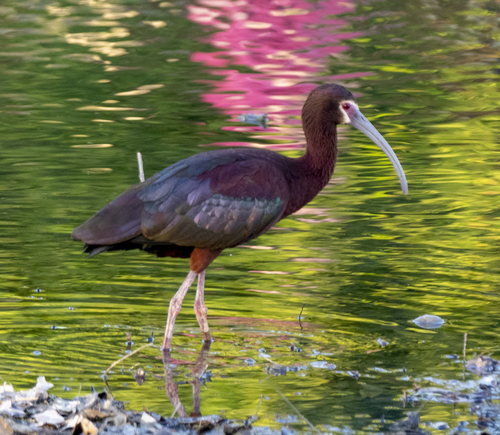
White-faced Ibis
Plegadis chihi
A shimmering visitor from the wetlands, the White-faced Ibis is a master of the mud. With its metallic plumage and scythe-like bill, this social wader turns any flooded field into a prehistoric display of elegance.
Quick Identification
Size
Length: 18–22 in (46–56 cm); Wingspan: 37 in (94 cm); Weight: 16–18 oz (450–525 g)
Colors
Breeding adults have deep maroon bodies with metallic green and purple iridescence on the wings. They feature a distinct white feathered border around the red facial skin. Non-breeding birds and juveniles are mostly gray-brown.
Key Features
- Long, downward-curving de-curved bill
- White feathered ring surrounding a red face patch (breeding)
- Deep reddish-maroon plumage with metallic sheen
- Long, dark legs and bright red eyes
When You’ll See Them
Sightings on EverydayEarth
Apr 13, 2026
A White-faced Ibis stands at the muddy edge of a waterway, meticulously preening its iridescent feathers. It occasionally turns its head, revealing its long, down-curved bill against the backdrop of lush green marsh vegetation.
Mar 31, 2026
A peaceful early morning scene at the refuge shows several bird species sharing a shallow marsh. In the foreground, a White-faced Ibis preens its feathers near the reeds while a Greater Yellowlegs forages actively in the center. To the right, a Black-necked Stilt stands on its exceptionally long legs. In the background, a Northern Pintail swims across the calm water as the morning sun illuminates the dry vegetation.
Behavior
The White-faced Ibis is a highly social and gregarious bird, almost always found in the company of others. They are famous for their coordinated foraging technique, where a flock moves across a flooded field or marsh in a loose line, rhythmically probing the mud with their sensitive bills. This 'stitching' motion allows them to feel for prey that they cannot see. They are strong flyers, often traveling in V-formations or long, undulating lines between their nighttime roosts and daytime feeding grounds.
In a backyard or suburban setting, they are relatively wary but can become accustomed to human presence if not directly approached. They are colonial nesters, often building platform nests in reed beds alongside herons and egrets. Their vocalizations are a series of low, nasal 'waa-waa' sounds, which can become quite loud when a large flock is gathered. Watching them come in for a landing is a treat, as they often perform side-slipping maneuvers to lose altitude quickly before touching down with surprising grace.
EverydayEarth exclusive
Camera Tips
To capture the incredible metallic luster of the White-faced Ibis, camera placement is critical. These birds are ground-feeders that keep their heads down while probing, so you should mount your camera very low—ideally 10 to 15 inches off the ground. Position the camera near the edge of a muddy bank or a shallow puddle. This 'worm's-eye view' captures the intricate white feathers around the face and the vivid red of the eye which are often lost when looking down from a high fence post.
Light is your best friend and worst enemy with this species. Because their feathers are iridescent, they can look like flat black crows in poor light or harsh midday sun. Aim your camera to face North or South to avoid direct lens flare, and rely on the 'Golden Hour' (early morning or late afternoon). The low angle of the sun during these times will hit the feathers and reveal the hidden greens, purples, and bronzes that make this bird so spectacular.
If you are using an AI-powered camera, set it to a high sensitivity with a short trigger interval. Ibises tend to move in groups; a single trigger might catch the first bird, but a fast recovery time will capture the entire flock as they parade past the lens. Using 'Burst Mode' is highly recommended, as their rapid head-bobbing and probing motion can result in blurry shots if the shutter speed isn't fast or if you only take one photo at a time.
While you shouldn't use food bait, you can 'lure' them with habitat. If you have a sprinkler system or a low spot in your yard, creating a temporary 'flood' or keeping a patch of lawn extra damp will attract them, especially during migration. They are drawn to the sound of splashing water and the sight of other white or dark wading birds, so placing your camera near a birdbath or a small water feature can increase your chances of a close-up encounter.
Similar Species
Species that look similar or are commonly confused with White-faced Ibis.
Frequently Asked Questions
Record White-faced Ibis at your habitat
Connect a camera to start building your own species record — AI identifies every visitor automatically.