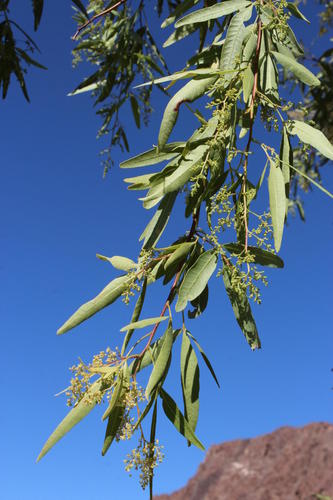
White Karee
Searsia pendulina
A fast-growing icon of the African landscape, the White Karee provides a weeping canopy of shade and a bountiful buffet for backyard birds.
Quick Identification
Size
Typically reaches 6-10 metres (20-33 feet) in height with a canopy spread of 5-8 metres (16-26 feet).
Colors
Light green to olive-green foliage; young bark is smooth and pale grey/white, maturing to a darker, rougher grey-brown.
Key Features
- Graceful weeping growth habit similar to a willow
- Trifoliate leaves with three narrow, lance-shaped leaflets
- Small, inconspicuous greenish-yellow flowers in spring
- Bunches of small, round, edible drupes that turn reddish-brown when ripe
When You’ll See Them
Geographic range
Where Does the White Karee Live?
Native to the southern African continent, the White Karee is primarily found in the arid and semi-arid regions of Namibia and the western provinces of South Africa. It occurs most frequently along the banks of the Orange River and its many tributaries, though its popularity as an ornamental tree has seen it introduced to gardens and urban landscapes throughout the rest of southern Africa. It is a hardy survivor that thrives in both the dry, rocky soils of the interior and the more fertile soils found in suburban environments.
Basemap © OpenStreetMap contributors
Behavior
The White Karee is a remarkably fast-growing and resilient tree, known primarily for its elegant, drooping branches that provide dense, dappled shade. As a semi-deciduous species, it may lose its leaves during particularly harsh or cold winters, but in more temperate suburban environments, it often remains green year-round. It is highly valued in landscaping because it is wind-resistant, frost-hardy, and possesses a non-invasive root system, making it safe to plant near paving or buildings.
Ecologically, the tree plays a vital role as a pioneer species. It establishes itself quickly in disturbed soils or along riverbanks, providing immediate cover for wildlife. In a backyard setting, it acts as a central hub for biodiversity; its nectar-rich flowers attract a variety of pollinators, while its dense canopy offers a safe nesting site for birds and a hunting ground for arboreal lizards and insects.
EverydayEarth exclusive
Camera Tips
When using an AI-powered camera to monitor a White Karee, the best approach is to treat the tree as a natural stage for animal activity. Because of its weeping habit, the outer 'curtain' of leaves is where small birds like Cape White-eyes and Sunbirds will spend most of their time foraging. Place your camera on a nearby fence or a sturdy stand about 2-3 metres away from the foliage, focusing on a patch of the tree that receives good morning light.
The trunk of the White Karee is a highway for climbing wildlife. To capture images of reptiles like Southern Rock Agamas or small mammals like Tree Squirrels, mount your camera directly to the trunk about 1.5 metres (5 feet) up. Angle the camera slightly downward to catch movement as animals descend from the canopy to the ground. Use a high-sensitivity motion trigger, as these movements can be very fast.
During the fruiting season (late summer to autumn), the base of the tree becomes a 'hot spot' for activity. Position a ground-level trail camera roughly 3 metres from the trunk, aimed at the area where fallen berries accumulate. This is an excellent way to capture terrestrial birds like Guineafowl or even small antelope in more rural settings. Ensure your camera's shutter speed is fast to avoid motion blur during the frantic feeding activity.
Lastly, the dense canopy of the White Karee is a preferred roosting spot for owls and other nocturnal birds. If your camera has high-quality infrared or night vision, try aiming it toward a thick, horizontal fork in the upper branches. This is the most likely spot to catch a Spotted Eagle-Owl or a Scops Owl resting during the day or preparing for a night hunt.
Frequently Asked Questions
Record White Karee at your habitat
Connect a camera to start building your own species record — AI identifies every visitor automatically.