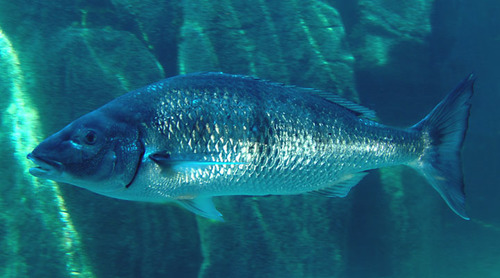
White Steenbras
Lithognathus lithognathus
South Africa's 'Silver Ghost' is a master of the surf and a specialist of the sandy shallows. Endangered and endemic, the White Steenbras represents the delicate balance of our coastal ecosystems.
Quick Identification
Size
Typically 60-100 cm (24-39 inches), but can reach 200 cm (78 inches); weighs up to 30 kg (66 lbs).
Colors
Silvery-grey to metallic white. Juveniles have 7-10 distinct vertical dark bars on their sides, which fade to a uniform silver as they mature.
Key Features
- Long, pointed snout with thick, fleshy lips
- Elongated silvery body with a slightly arched back
- Vertical dark bars on the flanks (most visible in young fish)
- Lower jaw is shorter than the upper jaw
When You’ll See Them
Geographic range
Where Does the White Steenbras Live?
The White Steenbras is an endemic jewel of the African continent, found exclusively along the coastline of South Africa. Its natural range spans from the mouth of the Orange River on the Atlantic coast, curves around the Western and Eastern Cape, and reaches as far north as KwaZulu-Natal on the Indian Ocean coast. This localized distribution makes it a high-priority species for South African marine conservation efforts.
Basemap © OpenStreetMap contributors
Behavior
The White Steenbras is a sophisticated hunter of the sandy seafloor, known for its unique 'hydraulic' feeding method. It uses its specialized mouth to blow powerful jets of water into the sand, excavating buried prey such as worms and crustaceans. This behavior leaves behind visible depressions in the sand known as 'blowholes,' which are a telltale sign that a shoal has recently passed through the area.
These fish are highly social, especially during their younger years, forming large shoals in estuaries which serve as vital nurseries. As they mature, they move into the turbulent surf zones of the open ocean. They are famous for their long-distance spawning migrations; adult populations travel hundreds of kilometers along the South African coast to reach specific spawning grounds, such as the Tugela Bank, before returning to cooler southern waters.
EverydayEarth exclusive
Camera Tips
Capturing the White Steenbras on camera requires specialized underwater equipment, as these fish are incredibly wary of movement and shadows. If you live near a South African estuary or a calm bay, the best approach is to use a stationary, weighted underwater camera housing positioned during low tide. Place the camera near 'nursery' channels or areas where sand prawns are abundant, as these are the primary feeding grounds for juvenile and sub-adult Steenbras.
For the best results, orient your camera at a low angle (about 15-20 cm off the bottom) looking across a patch of flat sand. This allows the AI to capture the distinct profile of the fish as it tilts its head downward to feed. Because the water in their preferred habitat is often turbid due to wave action, use a wide-angle lens with a short focal distance. Avoid using white-light strobes, which will spook the fish and cause 'backscatter' (reflections off sand particles); instead, rely on high-ISO settings or natural ambient light during the early morning hours.
Timing is critical for success. Set your camera to record during the two hours following low tide, as the incoming water brings these fish into the shallows to forage. In backyard estuary settings, look for submerged structures or drop-offs where the current slows down, as Steenbras often hover in these spots. If you are using an AI-triggered system, ensure the motion sensitivity is adjusted to account for swaying seaweed or floating debris common in the surf zone.
Frequently Asked Questions
Record White Steenbras at your habitat
Connect a camera to start building your own species record — AI identifies every visitor automatically.