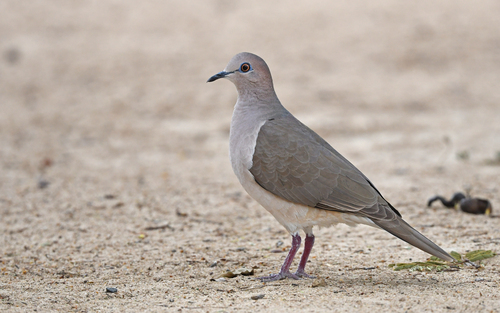
White-tipped Dove
Leptotila verreauxi
A ghost of the undergrowth, the White-tipped Dove is a master of subtlety. With its soft lavender hues and haunting, hollow call, this elegant ground-dweller is a prized find for any backyard observer in the Americas.
Quick Identification
Size
Length: 26-30 cm (10-12 in); Weight: 155-215 g (5.5-7.6 oz); Wingspan: 44-48 cm (17-19 in)
Colors
Soft grayish-brown upperparts and creamy-white underparts. The breast has a delicate pinkish-lavender wash, and the forehead is pale buff. The underwings are a striking cinnamon color, visible only in flight. Males and females look nearly identical.
Key Features
- Broad, rounded tail with prominent white tips on the outer feathers
- Red or orange-red skin forming a ring around the eyes
- Pale, buffy-pink forehead and breast contrasting with a grayish crown
- Cinnamon-colored underwing linings visible when the bird takes flight
When You’ll See Them
Sightings on EverydayEarth
Apr 21, 2026
A White-tipped Dove is perched on the edge of a fruit feeder. It spends several moments pecking at halved oranges before hopping across the tray and eventually flying out of the frame.
Behavior
The White-tipped Dove is a shy, ground-dwelling species often described as more elusive than its cousin, the Mourning Dove. Unlike many other pigeons and doves that congregate in large, noisy flocks, these birds are typically found alone or in pairs. They spend most of their time walking slowly on the forest floor or under garden shrubbery, bobbing their heads in a rhythmic motion as they search for food.
When startled, they prefer to retreat into dense cover on foot rather than taking flight. If they do fly, their wings produce a distinct whistling sound, though it is less metallic than that of a Mourning Dove. Their presence is most frequently announced by their low, mournful call—a hollow 'who-wooooo' that sounds like someone blowing across the top of a glass bottle. This call is easy to overlook as background noise or mistake for an owl in the distance.
EverydayEarth exclusive
Camera Tips
To capture high-quality footage of the White-tipped Dove, the most critical factor is camera height. Because these birds are almost exclusively ground-feeders, your AI camera should be mounted no higher than 12 to 18 inches off the ground. If you place the camera too high, you’ll likely only see the tops of their heads as they forage. Aiming the camera slightly upward from a low vantage point provides a much more intimate 'eye-level' perspective that showcases their delicate facial features and red eye-rings.
Location is everything with this secretive species. They are rarely seen in the middle of an open lawn. Instead, place your camera along the 'edge zones'—the transition area between a manicured garden and dense brush or woods. They feel safest when they are within a few feet of a quick hiding spot. If you have a drip or a low-profile birdbath, this is a prime location; White-tipped Doves are frequent drinkers and prefer water sources that are at ground level rather than elevated pedestals.
For baiting, these doves are particularly fond of cracked corn, white proso millet, and sunflower hearts scattered directly on the ground or on a low platform feeder. Since they are slow-moving and cautious, set your camera's trigger interval to be relatively short or use a 'Video' mode with a 15-20 second duration. This ensures you catch the subtle head-bobbing behavior and their cautious approach to the feeding area. During the summer months, they are most active in the early morning and late afternoon to avoid the midday heat, so ensure your camera is positioned to avoid direct lens flare during these golden hours.
Finally, keep an eye on your camera's motion sensitivity settings. White-tipped Doves often stand perfectly still for long periods, scouting for predators before they begin feeding. A camera with pre-roll or high sensitivity will help ensure you don't miss the moment they emerge from the shadows. If you are using an AI-powered camera, make sure the lens is clear of low-hanging grass or twigs that might trigger false recordings in the wind, as the dove's preferred habitat is often cluttered with such vegetation.
Similar Species
Species that look similar or are commonly confused with White-tipped Dove.
White-winged Dove
Look for the bold white wing patch and a square tail; White-tipped Doves have white only on the tail tips and cinnamon underwings.
Mourning Dove
Mourning Doves have long, pointed tails and black spots on their wings, while White-tipped Doves have rounded tails and lack wing spotting.
Eurasian Collared-Dove
Eurasian Collared-Doves have a distinct black 'collar' on the back of the neck and are much larger and lighter in color.
Frequently Asked Questions
Record White-tipped Dove at your habitat
Connect a camera to start building your own species record — AI identifies every visitor automatically.