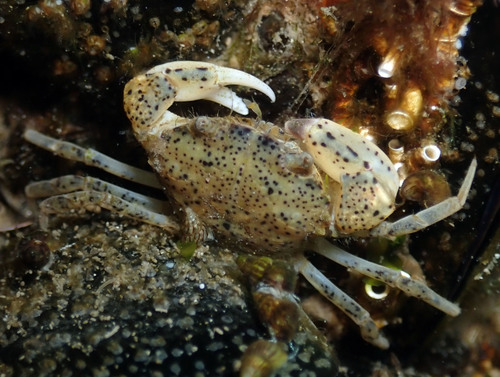
White-tipped Mud Crab
Rhithropanopeus harrisii
The White-tipped Mud Crab is a tiny but tough inhabitant of our coastal waterways. Recognized by its distinctive 'white-manicured' claws, this master of the estuary is a vital link in the salt marsh food web.
Quick Identification
Size
Carapace width of 10-26 mm (0.4-1.0 inches)
Colors
Olive-green, brownish-gray, or nearly black carapace with distinctive white or pale-colored tips on the claws
Key Features
- Small, rectangular carapace with four teeth on each side
- Distinctive white or light-tipped claws (chelae)
- Unequal claw sizes, especially in males
- Dull, camouflaged coloration suited for muddy bottoms
When You’ll See Them
Geographic range
Where Does the White-tipped Mud Crab Live?
The White-tipped Mud Crab is native to the Atlantic coast of the Americas, with a primary range extending from the cold waters of New Brunswick, Canada, southward through the United States to the Gulf of Mexico and Veracruz, Mexico. This hardy species has also become a successful global traveler, establishing invasive populations across Europe—from the North Sea to the Caspian Sea—and along the Pacific coast of North America. Its ability to hitchhike in ship ballast water has made it one of the most widely distributed small crabs in the world.
Basemap © OpenStreetMap contributors
Behavior
The White-tipped Mud Crab is a secretive and resilient crustacean known for its incredible tolerance to varying salinity levels. Unlike many other crabs that require high-salinity seawater, this species thrives in brackish estuaries and can even survive in near-freshwater conditions. It is a largely nocturnal creature, spending its daylight hours tucked away in the safety of oyster reefs, submerged woody debris, or deep within muddy burrows to avoid predators like wading birds and larger fish.
While relatively small, these crabs are active scavengers and play a crucial role in their ecosystem by processing organic detritus. They are not particularly aggressive compared to larger crab species, but they are highly opportunistic foragers. In suburban coastal areas, they are often found in high densities where human-made structures like docks, riprap, and pilings provide ample hiding spots and surfaces for algae and barnacle growth.
EverydayEarth exclusive
Camera Tips
Capturing the White-tipped Mud Crab on camera requires a specialized approach since they are primarily aquatic and very small. For the best results, use a waterproof action camera or a dedicated underwater trail camera. Position your device at the edge of a salt marsh or near a pile of oyster shells during a high tide. The camera should be angled downward or placed at a side-view profile very close to the substrate—ideally 10 to 15 inches away—to ensure the AI can detect the small movements of the crab against the mud.
Baiting is highly effective for drawing these crabs out of their hiding spots. Place a small mesh bag filled with crushed oysters, clams, or a piece of oily fish like mackerel directly in front of the lens. Secure the bait with a tent stake or a heavy rock to prevent it from drifting away with the tide. Because these crabs are nocturnal, ensure your camera is set to record in high-definition infrared mode. Standard white flashes may startle them and cause them to retreat into their burrows, but IR light allows for natural behavior capture.
Pay close attention to the tide cycles in your backyard or local waterway. The best footage is often captured during the 'slack' periods of high tide when water movement is minimal, allowing the crabs to forage without fighting heavy currents. If you are filming in a suburban canal or dock area, mounting the camera to a piling just above the mud line can capture the crabs as they scuttle between barnacles and anemones. During the summer months, look for females carrying a dark mass of eggs—known as being 'berried'—for a fascinating look at their reproductive cycle.
Frequently Asked Questions
Record White-tipped Mud Crab at your habitat
Connect a camera to start building your own species record — AI identifies every visitor automatically.