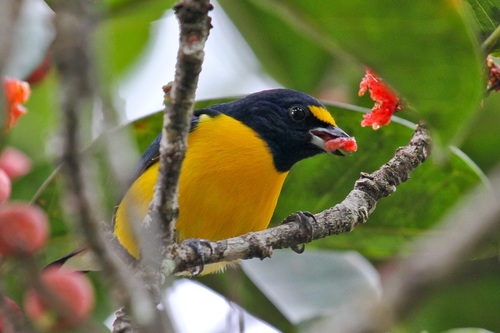
White-vented Euphonia
Euphonia minuta
A tiny jewel of the tropical canopy, the White-vented Euphonia is a master of the forest edge. With its vibrant yellow plumage and distinctive white underside, this small bird is a rewarding discovery for any backyard camera enthusiast.
Quick Identification
Size
Length: 9–10 cm (3.5–3.9 in); Weight: 8–11 g (0.28–0.39 oz)
Colors
Males have glossy blue-black upperparts, a bright yellow forehead and breast, and a distinct white lower belly (vent). Females are olive-green above and paler, yellowish-white below.
Key Features
- Distinctive white patch under the tail (the vent)
- Stubby, thick dark bill
- Male has a yellow forehead patch that doesn't reach the eye
- Compact, short-tailed silhouette
When You’ll See Them
Behavior
The White-vented Euphonia is an energetic and social little bird, often found moving through the canopy in pairs or small family groups. Unlike some of its more aggressive cousins, this species is relatively inconspicuous and is frequently part of larger, mixed-species foraging flocks that include tanagers and honeycreepers. They are highly vocal, constantly emitting soft, high-pitched whistles and chirps as they move through the foliage.
While they spend much of their time high in the trees, they are known to descend to forest edges and even suburban gardens if the right food sources are available. Their flight is fast and undulating, typical of the finch family. In backyard settings, they are shy but can become regular visitors if they feel secure and have access to their preferred berry-producing plants.
EverydayEarth exclusive
Camera Tips
Capturing the White-vented Euphonia on camera requires a bit of strategy because of their small size and preference for the canopy. To bring them within range of a backyard AI camera, focus on their specific dietary needs. Mistletoe is their absolute favorite; if you have trees with mistletoe growth, mount your camera 5 to 10 feet away from these clumps at a slight downward angle. These birds are 'berry-pinchers'—they squeeze the seeds out of berries—which makes for excellent high-speed video captures.
Because they are tiny, standard PIR motion sensors can sometimes miss them. Increase your camera's sensitivity to 'High' and set a short trigger interval (less than 1 second). If you are using a feeder, avoid standard seed mixes; instead, offer halved bananas or oranges on a platform feeder. Mount the camera at eye level with the feeder, roughly 3 to 5 feet away, to capture the intricate details of the male's blue-black plumage and the namesake white vent.
Water is another fantastic lure. A dripping birdbath or a small fountain with a gentle splash is irresistible to euphonias. Position your camera to face the sun (to avoid silhouettes) and focus on the area where the birds land to drink. Early morning is the best time for lighting, as their iridescent feathers can look flat in the harsh midday sun. During the nesting season, look for them carrying soft plant fibers; placing a camera near potential nesting sites in dense shrubbery can yield rare behavioral footage.
Similar Species
Species that look similar or are commonly confused with White-vented Euphonia.
Frequently Asked Questions
Record White-vented Euphonia at your habitat
Connect a camera to start building your own species record — AI identifies every visitor automatically.