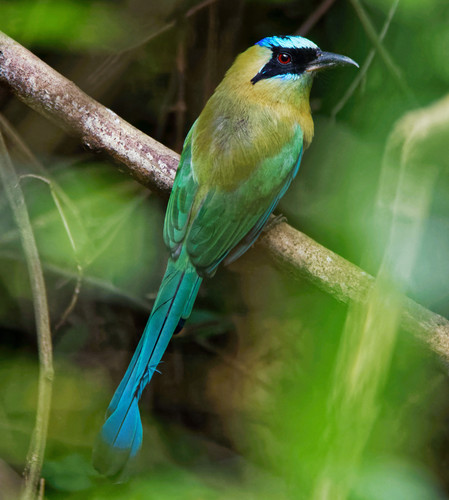
Whooping Motmot
Momotus subrufescens
With its brilliant blue crown and iconic racket-tipped tail, the Whooping Motmot is a crown jewel of the tropical backyard. Watch for its unique pendulum tail-swing as it keeps a watchful eye over its forest domain.
Quick Identification
Size
38–43 cm (15–17 inches) in length; 100–150g (3.5–5.3 oz) in weight
Colors
Luminous green back and wings; bright blue-fringed black crown; black mask; warm cinnamon-rufous underparts; long blue tail feathers with bare shafts and racket-shaped tips
Key Features
- Distinctive racket-shaped tail tips
- Bright blue 'diadem' crown with a black center
- Black 'bandit' mask across the eyes
- Pendulum-like tail swinging behavior
When You’ll See Them
Sightings on EverydayEarth
Mar 17, 2026
A Whooping Motmot perches prominently on the fruit feeder platform, displaying its vibrant rufous and green plumage and black facial mask. To its right, a Social Flycatcher sits on the edge of the platform. Shortly after, a Clay-colored Thrush flies in and lands on a branch near the red hummingbird feeder. The birds are actively foraging and observing their tropical surroundings.
Jun 17, 2026
A Whooping Motmot perches on a mossy branch before hopping down to the feeder platform to investigate the fruit. It displays its characteristic orange head and long tail while looking around the lush tropical environment.
Jun 14, 2026
A Whooping Motmot is perched prominently on a moss-covered branch behind the fruit tray. It remains watchful, turning its head from side to side to scan the surrounding tropical foliage.
Jun 11, 2026
A Whooping Motmot perches on a moss-covered branch on the left, turning its head to scan the surroundings. It then hops across the branch toward the center of the frame, pausing near a small hanging feeder.
Apr 18, 2026
A Whooping Motmot perches among the dense green foliage near the fruit feeder. It holds a small morsel of food in its bill and remains still while turning its head to scan the surroundings, showing off its vibrant cinnamon-colored plumage and signature black mask.
Apr 15, 2026
A pair of Whooping Motmots are perched on the right side of the branch, displaying their colorful plumage and distinctive masks. To the left, a Clay-colored Thrush is actively feeding on the fruit laid out on the platform.
Behavior
The Whooping Motmot is a bird of quiet contemplation and sudden, explosive action. It is famous for its 'pendulum display,' where it rhythmically swings its long tail from side to side like a clock. This isn't just for show; it is often a signal to potential predators that the motmot has spotted them, discouraging a surprise attack. While they are often solitary, they can be found in pairs during the breeding season, communicating with low-frequency 'whoop-whoop' calls that can travel long distances through dense foliage.
These birds are 'perch-and-sally' hunters, meaning they spend long periods sitting perfectly still on a shaded branch, scanning the ground or air for movement. Despite their bright colors, they can be surprisingly difficult to spot until they move. In suburban environments, they are known to be somewhat tolerant of humans, provided they have access to thick garden cover and high perches where they feel secure.
EverydayEarth exclusive
Camera Tips
To capture the stunning Whooping Motmot on camera, focus on their favorite 'sentinel' perches. These birds are creatures of habit and will often return to the same horizontal branch, usually 5 to 12 feet above the ground, to scan for prey. Position your camera at eye level with these branches in a shaded part of the garden. Because they prefer low-light forest understories, ensure your camera has a high-quality sensor for low-light conditions or set your AI trigger to its highest sensitivity to catch them before they fly off.
Water is a powerful lure for motmots. A pedestal birdbath or a stone basin with a small solar fountain or dripper is irresistible to them, especially in the afternoon. Set your camera 6 to 9 feet away from the water source at a 45-degree angle. This angle allows the camera to capture the full length of the bird, including those iconic racket-tipped tail feathers, which can be nearly a foot long. If you use a trail camera, ensure the 'trigger speed' is fast, as they can drop from a perch to the ground and back in a split second.
If you are lucky enough to have an earthen bank or a steep slope on your property, keep an eye out for 2-3 inch wide holes. These may be motmot nesting burrows. Positioning a camera nearby (at a respectful distance of at least 15 feet to avoid disturbance) can provide incredible footage of the birds carrying large insects or small lizards back to their young. For the best color reproduction, try to angle the camera so the bird is side-lit; direct midday sun can wash out the subtle blues and greens of their plumage.
Lastly, pay attention to the 'pendulum' behavior. If your camera has a video mode, use it instead of still photos. The rhythmic wagging of the tail is the Whooping Motmot's most charismatic trait and is far more impressive in motion. Set your video clips to at least 15-20 seconds to ensure you capture the full cycle of the tail swing and the bird's distinctive 'whoop' vocalization if your camera records audio.
Similar Species
Species that look similar or are commonly confused with Whooping Motmot.
Lesson's Motmot
Lesson's Motmot has a more greenish breast and a harsher, more croaking call compared to the rufous-bellied Whooping Motmot.
Amazonian Motmot
The Amazonian Motmot is found further south and east and has a different pattern of blue on its crown.
Rufous Motmot
Much larger with an almost entirely rufous body and lacks the distinct blue diadem crown of the Momotus genus.
Frequently Asked Questions
Record Whooping Motmot at your habitat
Connect a camera to start building your own species record — AI identifies every visitor automatically.