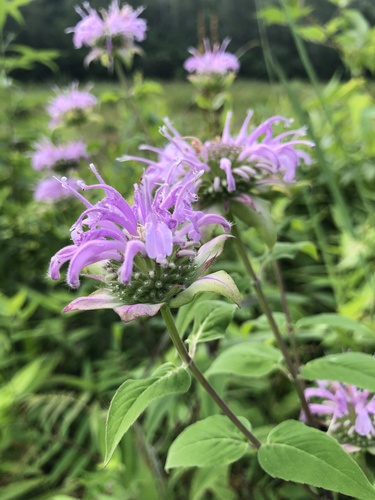
wild bergamot
Monarda fistulosa
A summer icon of the American prairie, wild bergamot provides a spectacular burst of lavender color and an irresistible nectar buffet for hummingbirds and butterflies.
Quick Identification
Size
2 to 5 feet (60 to 150 cm) tall; 2 to 3 feet (60 to 90 cm) spread
Colors
Soft lavender, lilac, or pale pink petals; square green to reddish stems; dark green foliage
Key Features
- Distinctive ragged, 'shag-rug' flower heads comprised of dozens of tubular petals
- Aromatic lance-shaped leaves that smell like oregano or mint when crushed
- Square stems characteristic of the mint family
- Prominent grayish bracts (leaf-like structures) located directly beneath the flower cluster
When You’ll See Them
Behavior
Wild bergamot, often called bee balm, is a resilient and gregarious perennial that serves as a cornerstone of the North American prairie and backyard pollinator garden. It spreads primarily through underground rhizomes, forming dense, aromatic clumps that provide essential cover for small creatures. During the peak of summer, it acts as a bustling 'pollinator hub,' attracting a constant stream of activity from sunrise to sunset.
While it is famous for its medicinal and tea-making properties among humans, its social role in the wild is as a high-reward nectar source. It is particularly noted for its relationship with long-tongued insects and birds that can reach deep into its tubular flowers. In a garden setting, it is famously tough, often resisting deer and rabbits due to the high essential oil content in its leaves, which gives off a spicy, pungent scent.
EverydayEarth exclusive
Camera Tips
To capture the true magic of wild bergamot, you shouldn't just focus on the plant itself, but on the incredible diversity of visitors it attracts. Position your camera on a tripod or stake at the same height as the flower heads—roughly 3 to 4 feet off the ground. Angle the lens slightly downward to capture the 'landing pad' of the ragged petals. Because wild bergamot is a magnet for the Hummingbird Clearwing moth and various swallowtail butterflies, use a high shutter speed (at least 1/1000s) if your camera allows, or select 'Sports Mode' to freeze the rapid wing movement of these visitors.
Lighting is critical for this species. The soft lavender petals can easily appear washed out in harsh midday sun. For the best color saturation and detail in the tubular petals, set your camera to trigger during the 'golden hours' of early morning or late afternoon. If you are using a trigger-based trail camera, place it within 2-3 feet of a healthy cluster of blooms. This proximity is essential for capturing the intricate details of bumblebees and the delicate proboscis of butterflies as they probe for nectar.
Consider using 'Time Lapse' or 'Interval' mode rather than motion triggers if you are looking to document the 'pollinator parade.' Motion sensors on standard trail cameras can struggle to pick up the movement of smaller insects. By taking a photo every 30 seconds during the peak heat of the day, you are guaranteed to capture a fascinating inventory of your local insect biodiversity. In late summer, keep the camera rolling even as the flowers fade; the dried seed heads are a favorite of American Goldfinches, providing a whole new set of photographic opportunities.
Frequently Asked Questions
Record wild bergamot at your habitat
Connect a camera to start building your own species record — AI identifies every visitor automatically.