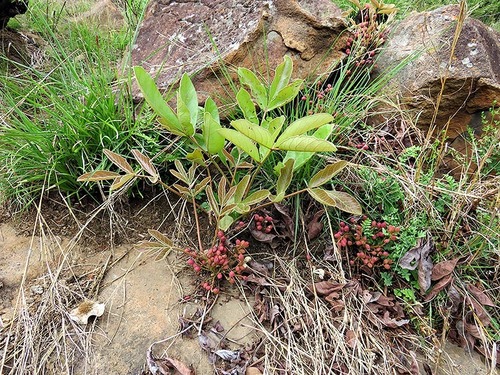
wild grape
Lannea edulis
The Wild Grape is an 'underground tree' that serves as a ground-level buffet for African wildlife. Its vibrant clusters of red and black berries attract everything from colorful birds to elusive nocturnal mammals.
Quick Identification
Size
A low-growing shrub typically 15–60 cm (6–24 inches) tall, though its underground woody rootstock can spread significantly wider.
Colors
Bright green leaves with paler, velvety undersides; flowers are creamy-yellow to pinkish; berries transition from green to bright scarlet red and finally purplish-black when ripe.
Key Features
- Low-growing 'underground tree' habit
- Clusters of grape-like berries appearing at ground level
- Large, leathery compound leaves with 3-7 leaflets
- Flowers appear on short, leafless stems in early spring
When You’ll See Them
Behavior
Lannea edulis, often called the 'Wild Grape' or 'Small Grape,' is a fascinating example of a geoxylic suffrutex—an 'underground tree.' While it appears to be a small shrub, most of its biomass is stored in a massive, woody root system beneath the soil. This is an evolutionary adaptation to survive the frequent bushfires and frost common in the African grasslands. In early spring, often after the first rains, it sends up short stems that burst into flower before the leaves even emerge.
Once the flowers are pollinated, the plant produces clusters of tart, fleshy berries. These fruits are a vital ecological resource, ripening at a time when other food sources might be scarce. Because the fruit is produced so close to the ground, it is accessible to a wide variety of wildlife that larger trees cannot reach. In human-populated areas, it is frequently foraged by locals for its refreshing, acidic juice and medicinal properties, though it remains a wild, non-domesticated species.
EverydayEarth exclusive
Camera Tips
Capturing wildlife around Lannea edulis requires a ground-level approach. Because the berries grow just inches above the soil, you should mount your trail camera on a short stake or use a specialized low-profile mount only 10–20 cm (4–8 inches) off the ground. Angle the camera slightly upward to capture the face of any animal leaning in to feed. This low angle provides an intimate, 'critter-eye view' that is far more engaging than a standard downward-angled shot.
To avoid a memory card full of 'false triggers,' clear any long blades of grass or swaying stems within two meters of the camera lens. Since this plant grows in open areas, wind can cause nearby vegetation to move constantly, triggering the PIR sensor. Using a 'High' sensitivity setting is recommended to catch smaller visitors like mongooses or francolins, but only if you have cleared the immediate foreground of debris.
Time-lapse mode is a secret weapon for this species. Set your camera to take a photo every 1–2 hours during the peak ripening month (usually October or November). This allows you to document the berries changing color from red to black and will help you predict exactly when the fruit is most attractive to animals. When you see the berries starting to disappear in your time-lapse, you know it’s time to switch the camera to high-definition video mode to catch the foragers in action.
At night, many nocturnal mammals like porcupines, genets, and even small antelope may visit the plant. Because the subject is so close to the ground, a powerful infrared flash can 'wash out' or overexpose the image, turning the berries into bright white blobs. If your camera allows it, set the IR flash to 'Low' or 'Power Save' mode. This will preserve the texture of the leaves and the dark richness of the ripe fruit, giving you much clearer night-time captures of the visitors.
Frequently Asked Questions
Record wild grape at your habitat
Connect a camera to start building your own species record — AI identifies every visitor automatically.