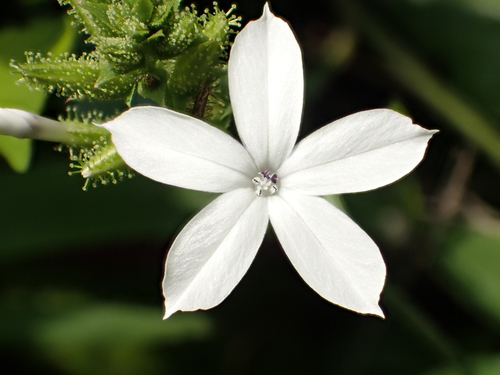
wild leadwort
Plumbago zeylanica
A resilient pantropical beauty, Wild Leadwort brightens the landscape with its snow-white blossoms and unique sticky seed pods. Often called the 'Doctorbush,' this versatile shrub is a magnet for local butterflies and a fascinating example of nature's 'hitchhiking' seed dispersal.
Quick Identification
Size
A scrambling shrub reaching 1–2 meters (3.3–6.6 feet) in height with a spread of up to 2.5 meters (8.2 feet).
Colors
Brilliant white flowers; deep green foliage; calyxes (flower bases) are covered in reddish-green sticky glandular hairs.
Key Features
- Five-petaled salverform white flowers
- Sticky, glandular hairs covering the calyx
- Scrambling or vine-like growth habit
- Simple, ovate leaves with a tapering base
When You’ll See Them
Behavior
Wild leadwort is a hardy, perennial evergreen shrub characterized by its sprawling and somewhat untidy growth habit. Unlike many garden plants, it doesn't use tendrils to climb; instead, it leans on surrounding vegetation or structures to reach for the sunlight. It is a highly resilient species, capable of thriving in poor soils and surviving extended periods of drought, making it a staple of wilder, unmanaged garden edges and forest fringes.
Ecologically, the plant is a master of hitchhiking. Its seed capsules are encased in a calyx covered in sticky, glandular hairs that act like natural Velcro. When an animal brushes against the plant, the seeds latch onto fur or feathers, allowing the species to disperse across vast distances. In a backyard setting, it serves as an essential nectar source, specifically attracting various species of 'Blue' butterflies whose larvae often feed on the foliage.
EverydayEarth exclusive
Camera Tips
To capture the beauty of Wild Leadwort, position your camera at a mid-level height, approximately 2 to 3 feet off the ground. Because this plant has a sprawling habit, a wide-angle lens is ideal for capturing the entire shrub, while a macro setting or lens is necessary to document the fascinating 'sticky' glands on the calyx. If you are using an AI-powered camera, aim it at a cluster of fresh blooms; these are hotspots for insect activity, which will trigger the motion sensors more frequently.
The best time for photography is during the golden hours of early morning or late afternoon. The pure white petals can easily 'blow out' or lose detail in harsh midday sun, so soft, angled light helps preserve the delicate texture of the flowers. If your camera allows for time-lapse, set it to trigger every 20 minutes during a warm morning to watch the new blossoms unfurl—a process that happens relatively quickly as the temperature rises.
Because Wild Leadwort is a primary host and nectar plant for the Common Cerulean and other Lycaenid butterflies, use this plant as a 'stakeout' location. Set your camera’s shutter speed to at least 1/1000th of a second if possible, or use a 'Sports' mode to freeze the motion of visiting pollinators. High-speed bursts are particularly effective here, as butterflies tend to flit quickly between the small, clustered flowers.
During the seeding phase, don't move your camera! The transition from the white flower to the sticky, burr-like seed pod is a great secondary subject. You may even catch 'wildlife action' in the form of birds or small mammals accidentally picking up these seeds. Ensure your lens is clean, as the plant itself can be quite 'messy' with its sticky secretions if it grows too close to your equipment.
Similar Species
Species that look similar or are commonly confused with wild leadwort.
Frequently Asked Questions
Record wild leadwort at your habitat
Connect a camera to start building your own species record — AI identifies every visitor automatically.