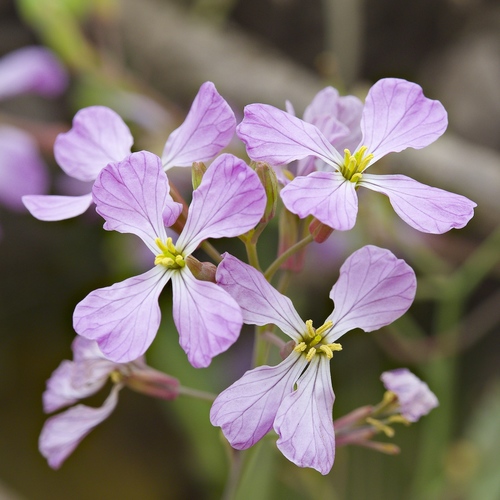
Wild radish
Raphanus raphanistrum
A hardy pioneer of the mustard family, the wild radish brings delicate, veined blossoms to the rugged edges of our suburban landscapes. While often dismissed as a weed, its role as a primary nectar source makes it a bustling center of backyard biodiversity.
Quick Identification
Size
Height ranges from 30 to 100 cm (12 to 40 inches); flower diameter is roughly 15 to 20 mm (0.6 to 0.8 inches).
Colors
Petals are typically white or pale yellow, occasionally light pink, featuring prominent dark purple or brownish veins.
Key Features
- Four-petaled flowers with distinct dark veining
- Bristly, hairy stems and lobed basal leaves
- Jointed seed pods (siliques) that break into ribbed segments
- Deep, sturdy taproot similar to a cultivated radish
When You’ll See Them
Behavior
Wild radish is a resilient annual or biennial plant known for its rapid colonization of disturbed soils. While it doesn't move in the animal sense, it exhibit's heliotropic-like tendencies where its flowers open fully during the day to greet pollinators and may partially close or droop during heavy rain or nightfall. It is a highly successful 'pioneer species,' often being the first to appear in recently tilled gardens, construction sites, or along the edges of footpaths.
In the backyard ecosystem, wild radish acts as a vital nectar hub. It is frequently surrounded by a buzz of activity, as its long blooming season provides a consistent food source for honeybees, hoverflies, and various butterfly species. However, gardeners should be aware of its competitive nature; it releases allelopathic chemicals into the soil that can inhibit the growth of certain neighboring plants, allowing it to form dense, colorful patches relatively quickly.
EverydayEarth exclusive
Camera Tips
To capture the best images of wild radish, position your camera at a 'worm's eye view'—about 12 to 18 inches off the ground. This low angle emphasizes the height of the flower stalks against the sky and allows for clear shots of the distinctive dark veins on the petals. Because the plant is often found in open, sunny areas, early morning or late afternoon 'golden hour' light is ideal to avoid harsh shadows on the white or yellow petals. Using a macro lens or a camera with a high-quality zoom will help you document the bristly hairs on the stem, which are a key identification feature.
Since wild radish is a magnet for insects, it is an excellent subject for a 'pollinator station' setup. Point your camera at a healthy cluster of blooms and use a fast shutter speed (at least 1/500s or higher) to freeze the motion of visiting bees and butterflies. If your AI camera has a motion-trigger setting, focus it on the most vibrant flower head in the patch. This is often the best way to get candid shots of rare butterflies that are too skittish for handheld photography.
Time-lapse photography is particularly rewarding with this species. Set your camera to take a photo every 15 to 30 minutes throughout a sunny day. When played back, you can see the flowers unfurling in the morning and subtly tracking the sun's position. For the best results, use a sturdy tripod or ground stake to ensure the plant remains centered in the frame, even if there is a light breeze. If it is a windy day, a small garden stake can be used to discreetly support the main stem to prevent motion blur.
Similar Species
Species that look similar or are commonly confused with Wild radish.
Frequently Asked Questions
Record Wild radish at your habitat
Connect a camera to start building your own species record — AI identifies every visitor automatically.