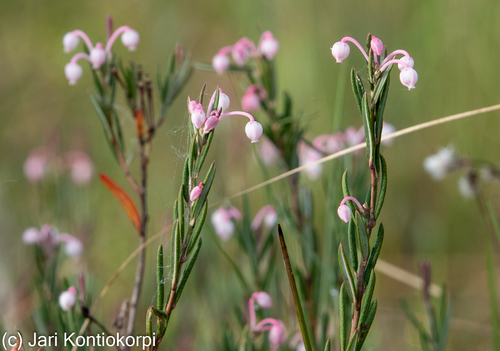
Wild Rosemary
Andromeda polifolia
A hardy survivor of the northern peatlands, the Wild Rosemary enchants with its delicate pink, bell-like blossoms and striking silvery foliage. While it shares a name with the common herb, this poisonous beauty is a true specialist of the world's most mysterious wetlands.
Quick Identification
Size
A low-growing shrub reaching 10–60 cm (4–24 inches) in height with a similar spreading width.
Colors
Blue-green to grey-green leathery leaves with silvery-white undersides; flowers are pale pink to white and urn-shaped.
Key Features
- Bell-shaped, nodding pink flowers in small clusters
- Narrow, evergreen leaves with edges that curl tightly downward
- Distinctive white waxy coating (glaucous) on the underside of leaves
When You’ll See Them
Behavior
Wild Rosemary, also known as Bog-rosemary, is a resilient evergreen shrub that has adapted to some of the harshest, most nutrient-poor environments in the Northern Hemisphere. Unlike its culinary namesake, this plant belongs to the heath family and is specialized for life in acidic peat bogs. It maintains its foliage year-round, utilizing a thick, waxy cuticle on its leaves to prevent moisture loss in both the biting winds of winter and the intense sun of open wetlands.
While it may look delicate with its nodding pink blossoms, Wild Rosemary is chemically formidable. It produces grayanotoxins, which serve as a natural defense mechanism against herbivores. This toxicity means that while it is beautiful to observe and photograph, it is not touched by most mammals. Instead, it forms a quiet, steady presence in the bog ecosystem, providing essential structure and nectar for specialized pollinators like bumblebees and certain bog-dwelling butterflies.
EverydayEarth exclusive
Camera Tips
When setting up an AI-powered camera to capture Wild Rosemary, your focus should be on the 'micro-wildlife' it attracts. Because the plant is low to the ground, mount your camera on a short ground spike or a tripod with a low-profile base. Position the lens 12 to 18 inches away from a healthy cluster of flower buds. This proximity allows your AI to trigger not just on the plant itself, but on the delicate pollinators like the Bog Fritillary butterfly or specialized bees that frequent the nodding, bell-shaped flowers during the late spring bloom.
For the best visual results, utilize the 'Golden Hour'—the hour after sunrise or before sunset. The silvery-white undersides of the leaves and the translucent quality of the pink flowers catch low-angle light beautifully, creating a glowing effect that highlights the plant's unique texture. If your camera supports time-lapse mode, Wild Rosemary is an excellent candidate for a 48-hour sequence during its peak flowering window in late May, allowing you to watch the clusters of 'bells' slowly expand and open.
Environmental protection is key in bog photography. Because these areas are wet and acidic, ensure your camera housing is fully waterproof and elevated slightly above the moss line to avoid moisture buildup in the battery compartment. If you are using an AI trigger for motion, set the sensitivity to high to capture the subtle movements of insects, as the plant itself will remain stationary unless there is significant wind. Avoid using heavy lures or baits, as the natural nectar of the flowers is the primary draw for the wildlife you'll want to document.
Frequently Asked Questions
Record Wild Rosemary at your habitat
Connect a camera to start building your own species record — AI identifies every visitor automatically.