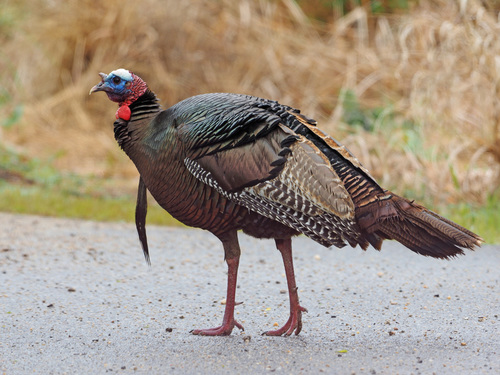
Wild Turkey
Meleagris gallopavo
The Wild Turkey is the heavy-weight champion of the North American forest, a bird of surprising intelligence and stunning metallic beauty. From their thunderous gobbles to their elaborate spring dances, these resilient birds are a captivating sight for any backyard observer.
Quick Identification
Size
Length: 100-125 cm (39-49 in); Wingspan: 1.2-1.4 m (4-5 ft); Weight: 2.5-11 kg (5-24 lbs)
Colors
Males feature iridescent bronze, green, and gold feathers with red/blue/white heads; females are a more muted, camouflaged brown and gray.
Key Features
- Iridescent plumage with copper and bronze highlights
- Fleshy, colorful head with wattle and snood
- Modified chest feathers forming a 'beard' on males
- Large, fan-shaped tail used in mating displays
When You’ll See Them
Sightings on EverydayEarth
Apr 23, 2026
A pair of White-Tailed Deer and a Wild Turkey share a quiet morning in a wooded clearing. One deer stands alert on the left while another is visible further back in the trees. In the center, the turkey moves along a fallen log, foraging through the leaf litter.
Apr 29, 2026
A Red Fox is seen exploring the leaf-covered forest floor. It carefully sniffs around the base of a large fallen log and moves through the clearing, appearing to be foraging or investigating the area.
Mar 26, 2026
A flock of Wild Turkeys moves into the clearing from the right, actively foraging through the fallen leaves and scanning the ground for food.
Mar 21, 2026
A wild turkey moves rapidly across the forest floor from right to left, its dark plumage standing out against the brown leaf litter before it exits the frame.
Jun 2, 2026
A Wild Turkey walks across the sun-dappled forest floor, foraging in the leaf litter as it moves steadily through the clearing.
Apr 3, 2026
A Wild Turkey enters from the lower right and walks across the leaf-covered forest floor. It pauses in the center of the frame and lets out a loud, visible gobble, stretching its neck and shaking its body, before continuing to forage through the woods.
Behavior
Wild Turkeys are highly social birds that travel in large groups called flocks or 'rafters.' While they spend their days on the ground, they are surprisingly powerful fliers over short distances and roost in the high branches of trees at night to stay safe from predators like coyotes and foxes. They are incredibly wary birds with eyesight three times sharper than a human's and a field of vision spanning nearly 270 degrees, making them a challenge to approach.
During the spring breeding season, males (known as Toms or Gobblers) perform elaborate courtship displays. They puff out their feathers, fan their tails, and drag their wings along the ground while emitting their famous 'gobble' to attract females (Hens). Outside of the breeding season, flocks are often segregated by sex, with hens and their young poults forming one group and mature males forming another.
EverydayEarth exclusive
Camera Tips
To capture the best footage of Wild Turkeys, place your camera low to the ground—about 12 to 18 inches high. This 'turkey-eye view' captures the intricate detail of their iridescent feathers and the unique textures of their heads. Avoid pointing the camera directly East or West, as the low morning and evening sun can wash out the metallic sheen of their plumage; a North-facing setup often provides the most consistent lighting for showing off their colors.
If you are using a camera on your own property, placing it near a known 'dusting' spot or a patch of open ground with cracked corn or birdseed can be highly effective. Turkeys are creatures of habit and will often visit the same clearing at the same time every morning. Because they travel in groups, use a wide-angle lens setting if your camera allows it, or back the camera away from the target area to ensure you capture the whole flock rather than just one bird's legs.
Settings are crucial for these birds. Use a 'Burst' or 'Multi-shot' mode because turkeys are constantly moving their heads and scratching the ground. If your camera supports video, set it to 15-30 second clips with a high-sensitivity microphone; hearing the 'thump' of a tom's wings or a distant gobble adds a spectacular layer of immersion to your backyard wildlife discovery. During the spring, look for 'strutting grounds'—flat, open areas where males perform—and position your camera there to catch the iconic fanned-tail display.
Similar Species
Species that look similar or are commonly confused with Wild Turkey.
Frequently Asked Questions
Record Wild Turkey at your habitat
Connect a camera to start building your own species record — AI identifies every visitor automatically.