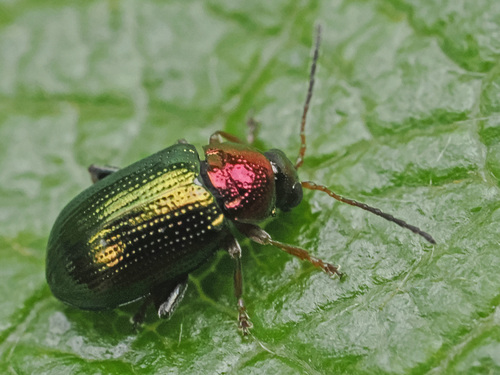
Willow Flea-beetle
Crepidodera aurata
A shimmering jewel of the riverside, the Willow Flea-beetle is a master of the high jump and a vibrant inhabitant of our native wetlands.
Quick Identification
Size
Length: 2.5–3.5 mm (0.10–0.14 inches)
Colors
Bicolored metallic sheen with copper or reddish-gold on the thorax (pronotum) and metallic green, blue, or gold on the wing cases (elytra).
Key Features
- Metallic bicolored body with copper thorax and green/gold wing cases
- Enlarged hind legs designed for powerful jumping
- Distinctive rows of fine punctures on the wing cases
- Associated almost exclusively with willow and poplar trees
When You’ll See Them
Geographic range
Where Does the Willow Flea-beetle Live?
The Willow Flea-beetle is a wide-ranging species native to the Palearctic realm, stretching from the British Isles and Wales across the entirety of Europe. Its territory extends through Northern Africa and across Northern and Central Asia, reaching as far east as the Korean Peninsula and Japan. It is particularly abundant in temperate regions where its favorite host plants—willows and poplars—grow near water or in moist garden soil.
Basemap © OpenStreetMap contributors
Behavior
The Willow Flea-beetle is a highly active and agile insect, best known for its remarkable jumping ability. When threatened or disturbed, it uses its oversized hind thighs to launch itself into the air, a defense mechanism that makes it appear to vanish instantly from a leaf. This "flea-like" jump is their primary way of escaping predators like birds and larger insects.
These beetles are sun-lovers and are most frequently observed basking on the upper surfaces of leaves during bright, warm days. While they are solitary feeders, they often aggregate in high numbers on a single host tree. They spend the majority of their adult lives grazing on foliage, creating a characteristic 'shothole' pattern in the leaves of their host plants. In the winter, they hibernate in leaf litter or under bark, emerging in the spring to mate and lay eggs near the roots or on the foliage of their preferred trees.
EverydayEarth exclusive
Camera Tips
Capturing the Willow Flea-beetle on camera requires a dedicated macro setup, as these tiny beetles are far too small for standard trail cameras to detect. If you are using an AI-powered camera or a smartphone-based backyard rig, you must use a macro lens attachment and set the focus distance to a fixed point on a willow branch. Look for 'shothole' damage—small, round holes in the leaves—as this is the best indicator of where the beetles are currently feeding.
Placement is critical; mount your camera on a stable, thick branch or a tripod nearby to avoid the swaying of thin willow twigs, which will trigger false motion alerts. Position your setup so the leaves are bathed in soft, indirect morning or afternoon light. Direct midday sun can reflect harshly off their metallic bodies, causing a 'glare' that obscures their beautiful colors and identification markings. Because they are so small, motion sensors might not always trigger; using a time-lapse mode set to one photo every 60 seconds is a much more reliable way to document their presence.
If you want to encourage them to stay in the frame, ensure you are targeting a plant with fresh, succulent new growth, as this is their preferred food. Avoid using any chemical sprays in the vicinity, as these beetles are very sensitive to garden treatments. During the peak of summer, you can often find dozens of them on a single small tree, providing ample opportunity for your camera to catch their metallic shimmer as they move between leaves.
Frequently Asked Questions
Record Willow Flea-beetle at your habitat
Connect a camera to start building your own species record — AI identifies every visitor automatically.