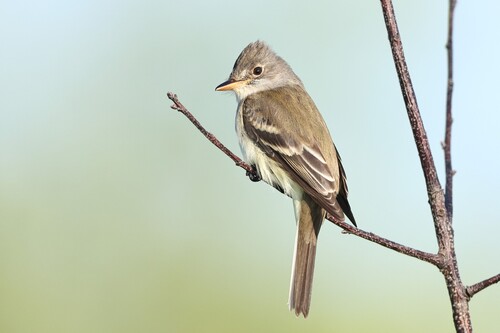
Willow Flycatcher
Empidonax traillii
A subtle sentinel of the wetlands, the Willow Flycatcher is a marvel of aerial agility. Recognizable by its buzzy song and upright posture, it is a prized find for any backyard wildlife enthusiast.
Quick Identification
Size
Length: 5.1–5.9 in (13–15 cm); Wingspan: 8.3 in (21 cm); Weight: 0.4–0.5 oz (11–14 g)
Colors
Dull olive-brown upperparts, whitish throat, and pale yellowish wash on the belly. Two whitish wing bars are present; the eye-ring is typically very faint or absent.
Key Features
- Distinctive 'fitz-bew' song
- Lack of a prominent white eye-ring
- Two pale wing bars on brownish wings
- Whitish throat contrasting with a darker head
When You’ll See Them
Behavior
The Willow Flycatcher is a master of the 'sally' foraging technique. It spends much of its day perched upright on exposed branches at the edges of thickets, scanning the air for movement. When it spots an insect, it darts out with incredible speed, snaps the prey mid-air with an audible click of its beak, and usually returns to the very same perch to consume its meal.
During the breeding season, these birds are highly territorial and vocal. While they aren't necessarily shy around humans, their preference for dense, brushy habitats can make them difficult to spot without the help of a camera. They are solitary migrants, traveling long distances from North American wetlands to wintering grounds in Central and South America, appearing in backyard habitats primarily during the late spring and summer months.
EverydayEarth exclusive
Camera Tips
To capture high-quality footage of a Willow Flycatcher, you must identify their favorite 'perching posts.' Look for dead twigs or slender branches that extend outward from dense shrubbery, especially those near a pond, stream, or damp area of your yard. These birds are habitual; once they find a good hunting perch, they will return to it dozens of times an hour. Mount your AI-powered camera 4 to 6 feet off the ground, angled slightly upward toward these exposed tips.
Because Willow Flycatchers do not visit traditional seed or suet feeders, you have to bait the area with 'habitat' rather than food. A bubbling water feature or a birdbath with a dripper is an excellent lure, as the movement of water attracts the flying insects they prey upon and provides a place for the birds to bathe. If your camera has a 'fast motion' or 'sports' setting, enable it; their aerial maneuvers are lightning-fast and can appear as a blur on standard settings.
Timing is everything with this species. In the late spring (late May to early June), males are at their most active as they establish territories. Use a camera with a sensitive microphone, as the AI is much more likely to trigger and identify the bird based on its buzzy 'fitz-bew' call before it even enters the frame. Ensure your camera is positioned to avoid direct backlight from the morning sun, which can wash out the subtle olive-gray tones needed for a positive species identification.
Similar Species
Species that look similar or are commonly confused with Willow Flycatcher.
Alder Flycatcher
Visually identical; distinguished only by its sharper 'free-beer' song and slightly different habitat preferences.
Least Flycatcher
Smaller in size with a much bolder, distinct white eye-ring and a sharp 'che-bek' call.
Eastern Phoebe
Lacks the prominent wing bars of the Willow Flycatcher and frequently wags its tail downward while perched.
Frequently Asked Questions
Record Willow Flycatcher at your habitat
Connect a camera to start building your own species record — AI identifies every visitor automatically.