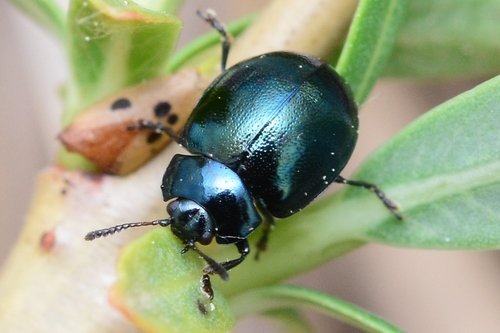
Willow Leaf Beetle
Plagiodera versicolora
A shimmering emerald of the garden, the Willow Leaf Beetle is a master of the macro world. These tiny metallic wonders turn ordinary backyard willows into a theater of fascinating social behavior and iridescent beauty.
Quick Identification
Size
3-5 mm (0.12-0.20 inches) in length
Colors
Brilliant metallic blue, dark green, or bronze-purple; glossy iridescent finish across the entire body
Key Features
- Rounded, oval-shaped convex body
- Metallic iridescent blue or green coloration
- Fine punctures (dimples) visible on the wing covers
- Strong preference for Willow and Poplar foliage
When You’ll See Them
Behavior
These beetles are surprisingly social during their larval stage, often lining up side-by-side to graze across a leaf in a coordinated fashion. When disturbed, adults have a 'drop and roll' defense mechanism, where they simply tuck in their legs and fall from the leaf into the tall grass below to escape predators. Despite their small size, they are strong fliers and can quickly colonize new host trees across suburban neighborhoods.
EverydayEarth exclusive
Camera Tips
Lighting is your best friend when filming iridescent insects. Position your camera so the sun is behind you, hitting the beetle's back; this will catch the metallic blue or green sheen that makes them so photogenic. If you are using an AI-powered backyard camera, ensure it has a macro lens attachment. Without a macro lens, the beetle will look like a tiny dark blur. If you can, pick a day with low wind, as willow branches are notorious for swaying, which can pull the beetle out of focus or create 'ghosting' in your images.
If you want to record the fascinating social behavior of the larvae, look for the 'gregarious' clusters on the undersides of lower leaves. These stay stationary for longer periods than the adults. For the best shots, use a white piece of foam board held slightly behind the branch to provide a clean background and reflect light onto the shaded underside of the leaves. Because these beetles are most active in high humidity and warm temperatures, early summer mornings after a light rain provide the most dramatic shots as water droplets cling to their metallic shells.
Similar Species
Species that look similar or are commonly confused with Willow Leaf Beetle.
Frequently Asked Questions
Record Willow Leaf Beetle at your habitat
Connect a camera to start building your own species record — AI identifies every visitor automatically.