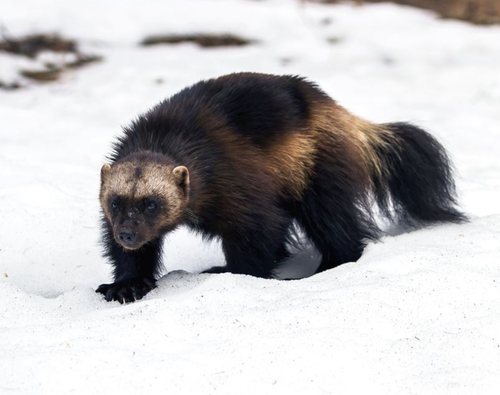
Wolverine
Gulo gulo
The ghost of the high country, the wolverine is a symbol of rugged endurance and untamed spirit. With the strength of a bear and the tenacity of a weasel, this elusive nomad thrives where few other creatures dare to tread.
Quick Identification
Size
Length: 65-107 cm (26-42 in); Weight: 9-25 kg (20-55 lb). Males are roughly 30% larger than females.
Colors
Dark chocolate brown to blackish fur with two prominent light-colored (buff or gold) lateral stripes running from the neck, along the flanks, to the base of the tail.
Key Features
- Powerful, bear-like stocky build with short legs
- Broad head with small rounded ears and a dark face mask
- Light-colored lateral stripes forming a 'U' shape along the sides
- Massive, furred paws that act as natural snowshoes
When You’ll See Them
Behavior
A wolverine is a nomad, often traveling up to 15-20 miles in a single day in search of food. They are primarily scavengers, using their incredible sense of smell to locate carrion buried deep under the snow. During the winter, they rely on the leftovers of larger predators or animals that succumbed to the elements. In the spring, females (jills) seek out deep snowpacks to dig dens, where the snow provides essential insulation for their kits against the freezing arctic air.
While they are mostly terrestrial, wolverines are surprisingly agile climbers and strong swimmers. Their social structure is strictly territorial, with male ranges often overlapping those of several females. They communicate through scent marking, using potent musk glands to signal their presence to other wolverines, which has earned them the nickname 'skunk bear.' Encountering one in the wild is a rare privilege, as their population densities are naturally very low.
EverydayEarth exclusive
Camera Tips
Capturing a wolverine on camera is the 'Holy Grail' for many trail camera enthusiasts. Because they have massive home ranges, your best chance of success is during the winter months when food is scarce and they are more likely to investigate a scent. Use a high-quality, cold-weather-rated camera with a fast trigger speed (under 0.25 seconds), as wolverines are constantly on the move and rarely linger in one spot unless there is a food reward.
The most effective way to photograph a wolverine is the 'vertical set' or 'Wolverine Run' method. Instead of mounting your camera to face a flat trail, find a sturdy tree and mount the camera about 5-6 feet high, angled downward toward the base of an adjacent tree. Apply a long-distance scent lure—specifically one containing skunk musk or fatty acid oil—to the trunk of the target tree about 6 or 7 feet up. This forces the wolverine to climb or stand on its hind legs to investigate the scent, giving you a clear view of its unique chest markings, which are used by researchers to identify individuals.
Position your camera in 'Burst Mode' or 'Multi-Shot' to capture the animal's movement as it climbs. Since wolverines are active in sub-zero temperatures, lithium batteries are a must; standard alkaline batteries will fail quickly in the high-latitude or high-altitude environments where wolverines live. If you are in a deep snow area, remember that your 3-foot-high mounting point in November might be buried by January, so check your setups periodically or mount them much higher than you think is necessary.
Video mode is highly recommended for this species. Seeing the lumbering, powerful gait of a wolverine provides much more personality and identification data than a static image. Ensure your PIR (passive infrared) sensor sensitivity is set to 'High' because their thick fur is such an incredible insulator that it can sometimes mask their body heat, making them 'invisible' to lower-quality camera sensors.
Similar Species
Species that look similar or are commonly confused with Wolverine.
American Badger
Badgers are shorter, flatter, and have a distinct white facial stripe, whereas wolverines are taller with a bear-like profile and gold flank stripes.
Fisher
Fishers are smaller and more slender with longer tails and uniform dark fur, lacking the wolverine's bulky frame and light-colored lateral bands.
Frequently Asked Questions
Record Wolverine at your habitat
Connect a camera to start building your own species record — AI identifies every visitor automatically.