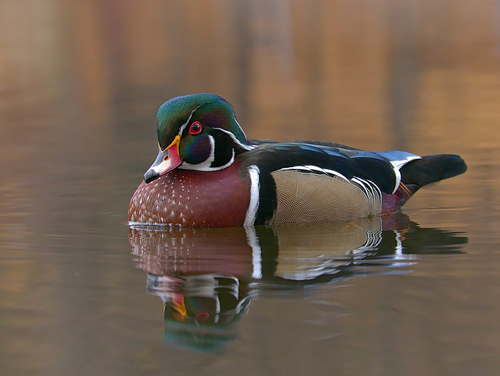
Wood Duck
Aix sponsa
The Wood Duck is arguably North America's most stunning waterfowl, sporting a kaleidoscope of iridescent feathers and a unique crested profile. Unlike most ducks, these colorful residents feel right at home high in the trees of your local woodland swamp.
Quick Identification
Size
Length: 18.5–21.3 in (47–54 cm); Wingspan: 26–28.7 in (66–73 cm); Weight: 1–1.9 lb (454–862 g)
Colors
Males feature iridescent green and purple heads with white stripes, a chestnut breast, and buff sides. Females are mottled grayish-brown with a distinct white teardrop shape around the eye.
Key Features
- Swept-back crested head profile
- Boxy, rectangular tail visible in flight
- Bright red-orange bill on males
- White 'teardrop' eye ring on females
When You’ll See Them
Behavior
Wood Ducks are unique 'perching ducks,' meaning they have strong claws capable of gripping branches and frequently roost in trees. Unlike many other waterfowl, they are quite shy and prefer the cover of overhanging branches and woody debris rather than open water. They are social but often found in smaller groups or pairs compared to the massive flocks of Mallards.
During the breeding season, they are famous for nesting in tree cavities or man-made nest boxes. They exhibit 'egg-dumping' behavior, where multiple females may lay eggs in a single nest box, sometimes resulting in 'super-clutches' of up to 40 eggs. While they are wary of humans, they can become accustomed to backyard ponds if there is sufficient dense cover nearby.
EverydayEarth exclusive
Camera Tips
To capture the best Wood Duck footage, location is everything. Look for 'loafing logs'—partially submerged logs or rocks where ducks climb out of the water to preen and rest. Place your camera about 12-18 inches above the water level, aimed across the log. Wood Ducks are easily spooked by sudden movements, so ensure your camera is well-camouflaged with local vegetation or a drab housing to blend into the shoreline.
If you have a nesting box on your property, this is your best chance for high-quality action. Position your camera on a nearby tree or post, about 5-10 feet away, angled toward the entrance hole. The most spectacular footage occurs in early summer when the ducklings leap from the nest box to the ground or water below. Set your camera to a high-speed video mode or a 3-5 shot burst to capture the rapid descent of the ducklings, which happens in a flash.
For ground-level foraging shots, scatter some cracked corn or black oil sunflower seeds near the water’s edge under the cover of low-hanging branches. Wood Ducks feel much safer feeding in the shadows than in the bright open sun. Because their plumage is highly iridescent, early morning or late afternoon sun provides the best lighting to bring out the emerald greens and deep purples of the male’s head without blowing out the highlights.
Check your camera settings for a fast trigger speed (under 0.5 seconds). Wood Ducks are quick to take flight, and a slow camera will often result in a 'ghost' of a wing or an empty frame. If your camera supports it, use a high PIR sensitivity during the morning hours, but be prepared to sort through some false triggers caused by moving water or swaying reeds.
Similar Species
Species that look similar or are commonly confused with Wood Duck.
Mandarin Duck
Males have prominent orange 'sail' feathers on their backs and an orange 'mane' around the neck.
Hooded Merganser
Possesses a similar crest, but the Merganser has a thin, serrated 'saw-bill' for catching fish and a large white patch on its crest.
American Wigeon
Lacks the Wood Duck's crest and has a distinct white forehead and green eye-patch rather than an iridescent head.
Frequently Asked Questions
Record Wood Duck at your habitat
Connect a camera to start building your own species record — AI identifies every visitor automatically.