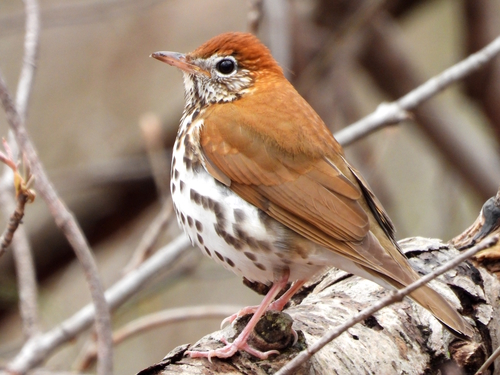
Wood Thrush
Hylocichla mustelina
The Wood Thrush is the hidden virtuoso of the eastern forests, known for its spotted breast and a song that sounds like a silver flute. Bringing a touch of wilderness to shaded backyards, this elegant bird is a master of the forest floor.
Quick Identification
Size
Length: 7.5-8.3 in (19-21 cm); Wingspan: 12-14 in (30-34 cm); Weight: 1.4-1.9 oz (40-54 g)
Colors
Upperparts are a warm cinnamon-brown on the head and neck, fading to an olive-brown on the back and tail; underparts are bright white with bold, dark brown to black circular spots.
Key Features
- Distinctive large black spots on a white breast and belly
- Bright reddish-cinnamon crown and nape
- Prominent white eye-ring
- Straight bill with a pinkish base on the lower mandible
When You’ll See Them
Behavior
The Wood Thrush is perhaps most famous for its ethereal, flute-like song, often described as one of the most beautiful in the North American woods. Unlike its bolder cousin, the American Robin, the Wood Thrush is a more reclusive bird, preferring the shaded understory of mature forests. It spends much of its time on the ground, hopping through leaf litter with a distinctive upright posture, pausing frequently to scan for movement or toss leaves aside in search of a meal.
While they are solitary during the winter, breeding pairs are highly territorial during the spring and summer. They are relatively calm around humans if provided with enough cover, but they will quickly retreat into deep shadows if they feel exposed. In a backyard setting, they are most often seen at the edges of wooded lots or in gardens that mimic a forest floor with plenty of mulch and shrubbery.
EverydayEarth exclusive
Camera Tips
To capture high-quality footage of a Wood Thrush, position your camera low to the ground, ideally between 6 and 18 inches high. This species is a dedicated ground-feeder, so aiming your lens at a patch of undisturbed leaf litter or a shaded garden bed will yield the best results. Because they prefer the shadows to avoid predators, ensure your camera is placed in a dimly lit area rather than direct sunlight, which can blow out the white feathers of their chest.
Water is a massive draw for the Wood Thrush. They are frequent visitors to ground-level bird baths or shallow water features, especially during the heat of mid-summer. Placing a camera near a dripping water source or a shallow stone basin can provide some of the most intimate 'bath time' footage. Because they are shy, try to place the camera in a spot where it is partially obscured by ferns or low-hanging branches to help the bird feel secure while it approaches.
Since the Wood Thrush is highly active during 'golden hour' when light is fading, use a camera with a high-quality low-light sensor or fast trigger speed. They move in quick, erratic hops followed by sudden freezes; setting your camera to a 'burst' mode or a short video clip (10-15 seconds) will help you capture that perfect still or a video of their unique 'head-cocked' listening behavior. Avoid using heavy white-light flashes, which can spook them; a subtle infrared setup is much better for those late-evening visits.
Similar Species
Species that look similar or are commonly confused with Wood Thrush.
Hermit Thrush
The Hermit Thrush has a reddish tail that contrasts with its brown back, whereas the Wood Thrush is reddest on its head.
Veery
The Veery has much lighter, less distinct spotting on the chest and a more uniform cinnamon-brown color across its entire back.
Swainson's Thrush
Swainson's Thrush has buffy 'spectacles' around the eyes and lacks the bold, circular spotting found on the Wood Thrush's belly.
Frequently Asked Questions
Record Wood Thrush at your habitat
Connect a camera to start building your own species record — AI identifies every visitor automatically.