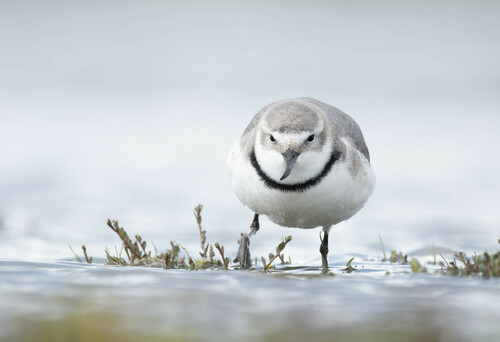
Wrybill
Anarhynchus frontalis
The Wrybill is a true New Zealand original, holding the title of the only bird in the world with a beak that always curves to the right. Masterfully camouflaged against river stones, this little plover is a highlight for any backyard observer near the coast or Canterbury rivers.
Quick Identification
Size
Length: 20–21 cm (8 in); Weight: 43–71 g (1.5–2.5 oz)
Colors
Pale grey upperparts, white underparts, and a single black breast band. In breeding season, males have a more prominent black band and a black stripe between the eye and beak.
Key Features
- Beak distinctly curved to the right
- Single black breast band (broader in males)
- Pale grey plumage that mimics river stones
- White forehead and belly
When You’ll See Them
Behavior
The Wrybill, or Ngutuparore, is a remarkable strategist. During the breeding season on the braided rivers of the South Island, they are highly territorial, using their perfectly camouflaged plumage to vanish against the grey river stones. They are famous for their 'broken-wing' distraction display, where they feign injury to lead potential predators away from their well-hidden nests on the ground.
Outside of the breeding season, these birds undergo a significant internal migration, flying north to settle in the large estuaries and mudflats of the North Island. In these wintering grounds, they become much more social, often forming large, tight-knit flocks that move in unison. They are relatively approachable compared to other shorebirds but remain constantly focused on the tidal cycle, which dictates their feeding and resting patterns.
EverydayEarth exclusive
Camera Tips
Capturing the Wrybill on camera requires a strategy focused on low-profile placement. Because these birds are ground-nesters and ground-feeders, your camera should be positioned as low as possible—ideally just a few inches off the ground—to get that intimate, eye-level perspective. On riverbeds, look for flat areas of grey shingle near slow-moving water channels. In estuarine environments, place cameras near known high-tide roosting spots where the birds congregate when the mudflats are submerged.
Since Wrybills are small and blend in perfectly with their surroundings, use a camera with a high-sensitivity PIR (Passive Infrared) sensor. You may need to decrease the detection trigger time to its fastest setting to catch them as they dart across the frame. Because they are diurnal, ensure your camera is optimized for daylight performance; high-resolution video is particularly rewarding for capturing their unique 'sideways' feeding motion, which is one of the most distinctive behaviors in the avian world.
Avoid using food lures, as these birds are specialized feeders. Instead, focus on 'landscape lures' like a slightly elevated driftwood log or a specific patch of fine silt where they might probe for insects. During the breeding season (August to December), be extremely careful not to disturb nesting sites, as their eggs are nearly invisible on the stones. If you are in a coastal backyard near an estuary, a shallow, ground-level birdbath with fresh water can sometimes entice them during the drier winter months.
Similar Species
Species that look similar or are commonly confused with Wrybill.
Frequently Asked Questions
Record Wrybill at your habitat
Connect a camera to start building your own species record — AI identifies every visitor automatically.