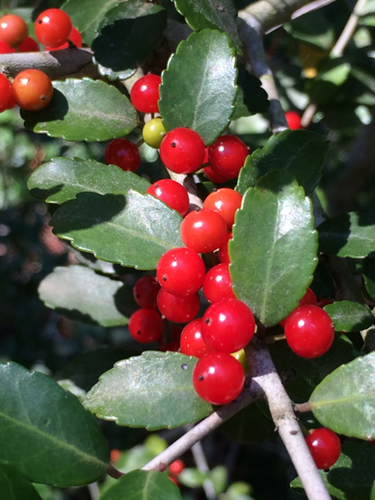
Yaupon Holly
Ilex vomitoria
The Yaupon Holly is more than just a beautiful evergreen; it is a caffeinated hub of backyard activity. From its shimmering red berries that sustain winter birds to its historical role as a ceremonial tea, this hardy native is a must-have for any wildlife enthusiast's camera setup.
Quick Identification
Size
A large shrub or small tree reaching 15–25 feet (4.5–7.5 m) in height and 10–15 feet (3–4.5 m) in width.
Colors
Glossy, dark green evergreen leaves; small, creamy white flowers; brilliant, translucent red berries on female plants; light gray to mottled bark.
Key Features
- Small, oval, leathery leaves with finely scalloped (crenate) edges
- Dense, twiggy growth habit often forming thickets
- Clusters of bright red drupes (berries) appearing in fall and winter
- Only native North American plant naturally containing caffeine
When You’ll See Them
Behavior
Yaupon Holly is a resilient, evergreen powerhouse that serves as a cornerstone of southeastern ecosystems. While it doesn't move like the animals we track, it exhibits a fascinating 'behavioral' role as a sanctuary. Its dense, twiggy structure provides essential nesting sites for songbirds and serves as a fortress against predators. In the spring, it produces inconspicuous but nectar-rich flowers that draw in a frantic parade of pollinators, including honeybees and native solitary bees.
As the only plant native to North America that contains caffeine, Yaupon has a deep historical relationship with humans. Indigenous peoples used the leaves to create 'Black Drink' for ceremonial purposes. Today, it is increasingly popular in backyard landscapes because it is incredibly hardy—shrugging off salt spray, drought, and poor drainage with ease. It acts as a slow-release pantry for wildlife; its berries are relatively low in fat, meaning birds often ignore them until late winter when other, tastier food sources have been exhausted.
EverydayEarth exclusive
Camera Tips
To capture the most action on your Yaupon Holly, position your camera at 'berry height.' Since female Yaupons produce fruit along the stems rather than just at the tips, focus your lens on a particularly berry-heavy branch about 4 to 6 feet off the ground. This is the sweet spot for visiting Cedar Waxwings, American Robins, and Eastern Bluebirds. Use a macro-focus setting if your camera supports it, as the birds will often land quite close to the foliage to pluck the fruit.
Lighting is your best friend when photographing this species. Try to angle your camera so it faces North or South; this prevents the morning or afternoon sun from blowing out the highlights on the glossy, reflective leaves. If you can catch the 'Golden Hour'—the hour after sunrise or before sunset—the red berries will appear to glow from within, making for stunning, professional-grade captures of the birds that visit.
Because Yaupon is a popular nesting site, consider placing a camera near the interior of the shrub during the spring (March-May). Avoid disturbing the bush, but aim the camera at a clear opening in the branches. You are likely to catch secretive behaviors from Northern Cardinals or Gray Catbirds as they navigate the dense thicket. Use a high-sensitivity trigger setting, as songbirds move with quick, twitchy motions that can be missed by slower sensors.
In the winter months, when the berries are the main draw, set your camera to 'Burst Mode' or 'Photo + Video.' Birds like Mockingbirds are highly territorial over Yaupon bushes and will often engage in dramatic aerial displays to chase off intruders. Capturing a sequence of photos will allow you to see these fast-paced interactions that the naked eye usually misses. If you are in a coastal area, keep the lens clean; the plant thrives in salt spray, but your camera lens does not!
Similar Species
Species that look similar or are commonly confused with Yaupon Holly.
American Holly
Much larger, spine-tipped leaves and a distinct tree-like growth habit compared to the Yaupon's small, scalloped leaves.
Dahoon Holly
Features longer, more elongated leaves and typically grows in much wetter, swampier soils than the adaptable Yaupon.
Chinese Holly
An invasive lookalike with very rectangular, extremely prickly leaves that lack the delicate scalloped edges of Yaupon.
Frequently Asked Questions
Record Yaupon Holly at your habitat
Connect a camera to start building your own species record — AI identifies every visitor automatically.