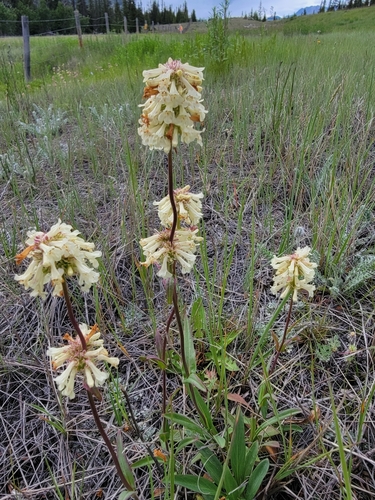
Yellow Beardtongue
Penstemon confertus
A resilient beauty of the Northern Rockies, the Yellow Beardtongue lights up mountain meadows with its unique, crowded clusters of sulfur-hued blooms.
Quick Identification
Size
Stems reach 10–50 cm (4–20 inches) in height; flowers are 1–2 cm (0.4–0.8 inches) long.
Colors
Creamy yellow to pale sulfur-yellow flowers with dark green, lance-shaped foliage; may have fine purple lines in the throat.
Key Features
- Tight, head-like whorls of flowers stacked along the upper stem
- Smooth, hairless stems and lance-shaped leaves
- Creamy sulfur-yellow tubular blossoms
- Sterile stamen (the 'beard') is usually hairless or slightly fuzzy.
When You’ll See Them
Geographic range
Where Does the Yellow Beardtongue Live?
Native to the interior Northwest of North America, the Yellow Beardtongue is a signature species of the Northern Rockies and the Columbia Basin. Its core range encompasses the US states of Washington, Idaho, and Montana, stretching northward into the Canadian provinces of British Columbia and Alberta. While it thrives in wild montane environments, it has also become a popular choice for native plant enthusiasts in suburban gardens across these regions.
Basemap © OpenStreetMap contributors
Behavior
Yellow Beardtongue is a perennial wildflower characterized by its 'conferted' or crowded growth habit. Unlike many other Penstemons that have loose, airy flower spikes, this species produces dense, compact clusters of blooms that appear in whorls around the upper stem. It spends the winter as a low-growing basal rosette of green leaves, sending up its flowering stalks as the temperatures rise in late spring.
As a key component of its native ecosystem, it acts as a primary nectar source for a variety of high-altitude pollinators. It is a hardy survivor, often colonizing rocky slopes and disturbed forest edges where soil nutrients are low. While it does not move like an animal, it exhibits a distinct seasonal 'behavior' by timing its bloom to coincide with the emergence of native bumblebees and mason bees.
EverydayEarth exclusive
Camera Tips
Capturing the Yellow Beardtongue on camera requires a different strategy than mobile wildlife. To get the best shots, place your AI-powered camera on a low-profile stake or small tripod just 12 inches from the ground. Angle the lens slightly upward to showcase the unique 'whorled' structure of the flower clusters and the delicate purple nectar guides inside the tubular petals.
Because the plant itself is stationary, the real action comes from its visitors. To capture the bumblebees, butterflies, and hummingbirds that frequent these blooms, use a 'Fast' trigger speed or 'Burst' mode. This ensures that you catch the rapid movement of pollinators as they hover near the creamy yellow spikes. If your camera supports it, high-sensitivity PIR settings are recommended to detect the heat signatures of larger insects.
For a unique perspective, try setting your camera to time-lapse mode during the peak blooming weeks of June and July. A photo taken every 30 minutes during daylight hours can reveal how the flower spikes develop and how the blooms track the sun. Position the camera facing North to ensure the pale yellow flowers are evenly lit by the sun without being washed out by harsh direct light or lens flare.
Finally, consider the background. Yellow Beardtongue is most striking when contrasted against a dark forest edge or a field of deep green foliage. Avoid placing the camera where tall grass will blow in front of the lens, as this can cause 'false triggers' and obscure the plant. Keep the area around the base of your target plant clear of debris to get a sharp, professional-looking species profile.
Similar Species
Species that look similar or are commonly confused with Yellow Beardtongue.
Frequently Asked Questions
Record Yellow Beardtongue at your habitat
Connect a camera to start building your own species record — AI identifies every visitor automatically.