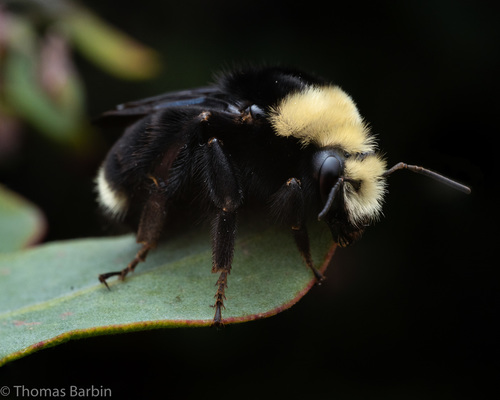
Yellow-faced Bumble Bee
Bombus vosnesenskii
Meet the most prolific pollinator of the West Coast. With its signature golden face and fuzzy black body, the Yellow-faced Bumble Bee is a welcome guest in gardens from British Columbia to Baja.
Quick Identification
Size
Queens: 18-21mm (0.7-0.8 in); Workers: 8-14mm (0.3-0.5 in); Males: 10-15mm (0.4-0.6 in)
Colors
Predominantly black with dense yellow hairs on the face and head. Features a single yellow band on the thorax and a distinct yellow band on the fourth abdominal segment.
Key Features
- Bright yellow hair covering the face and top of the head
- Single yellow stripe on the thorax closest to the head
- Mostly black abdomen with a single yellow band on the fourth segment
- Stout, fuzzy body typical of bumble bees
When You’ll See Them
Behavior
The Yellow-faced Bumble Bee is the most widespread and industrious bumble bee on the West Coast. These are highly social insects that live in colonies founded by a single queen who emerges from hibernation in early spring. You will often see workers busily moving from flower to flower, utilizing a technique called 'buzz pollination' where they vibrate their flight muscles to shake pollen loose from deep inside blossoms.
Compared to honey bees, these bumble bees are remarkably docile. They are much more interested in their floral work than in humans, making them excellent neighbors for backyard gardeners. In the late summer, the colony produces new queens and males, while the rest of the hive naturally dies off as the weather cools.
EverydayEarth exclusive
Camera Tips
To capture high-quality footage of the Yellow-faced Bumble Bee, your best strategy is to focus on 'landing pads'—specific flowers that are currently in full bloom. Because these bees are fast movers, set your AI camera or trail cam with a high trigger speed or use a dedicated macro lens if your device supports it. Position the camera roughly 6 to 12 inches away from a cluster of nectar-rich flowers like Salvia, Lavender, or California Poppies. This ensures the bee fills the frame when it lands to forage.
Natural lighting is your best friend when photographing fuzzy insects. Try to angle your camera so the sun is behind you or hitting the flowers from the side; this highlights the fine hairs and the vibrant yellow markings on the bee's face. Avoid placing the camera in deep shade, as the bee's black body can lose detail and blend into the background. If your camera allows for manual settings, a high shutter speed (1/1000 or higher) is essential to freeze the rapid movement of their wings.
For a unique perspective, look for 'patrolling' behavior. Early in the season, you might find queens flying low over the ground looking for nesting sites in abandoned rodent burrows. Placing a camera at ground level near a woodpile or a patch of undisturbed soil can capture these rare 'house-hunting' moments. During the heat of the summer, a shallow bee waterer (a dish with pebbles for them to land on) can also be a high-traffic area for your camera lens.
Similar Species
Species that look similar or are commonly confused with Yellow-faced Bumble Bee.
Frequently Asked Questions
Record Yellow-faced Bumble Bee at your habitat
Connect a camera to start building your own species record — AI identifies every visitor automatically.