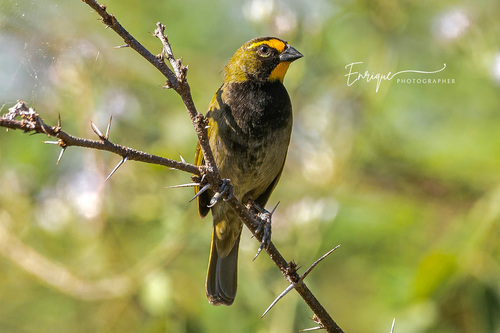
Yellow-faced Grassquit
Tiaris olivaceus
A tiny, dapper tanager of the grasslands, the Yellow-faced Grassquit is famous for its golden 'eyebrows' and energetic personality. This social seedeater is a frequent visitor to tropical gardens, where it dances through tall stalks in search of the perfect grain.
Quick Identification
Size
Length: 10–11 cm (4–4.3 in); Wingspan: approx. 15–17 cm (6–6.7 in); Weight: 8–11 g (0.28–0.39 oz)
Colors
Males feature olive-green upperparts, a black chest, and vibrant yellow patches on the throat and eyebrows. Females are a duller olive-gray with pale, buff-yellow face markings.
Key Features
- Bright yellow eyebrow and throat patches (males)
- Prominent black bib or chest patch (males)
- Short, thick conical bill for cracking seeds
- Olive-green back and wings
When You’ll See Them
Behavior
The Yellow-faced Grassquit is a social and energetic little bird, often found in small groups or mixed-species flocks outside of the breeding season. They are highly active foragers, frequently seen clinging to tall grass stems to reach seed heads or hopping along the ground in search of fallen grains. Their flight is typically short and jerky, moving from one clump of vegetation to the next with quick, fluttering wingbeats.
While they are relatively bold and adapt well to human-altered landscapes like gardens and parks, they can be skittish if approached too quickly. Males are known for their buzzy, high-pitched song, which they often deliver from a slightly elevated perch—such as a tall weed or a fence wire—to defend their small nesting territories. They are generally peaceful neighbors in a backyard setting and coexist well with other small seedeaters.
EverydayEarth exclusive
Camera Tips
To capture high-quality footage of Yellow-faced Grassquits, place your camera low to the ground, ideally between 6 and 18 inches high. These birds spend the majority of their time foraging in the 'understory' of the grass, so a camera mounted on a standard tripod or fence post will likely look right over their heads. Aim the lens toward a patch of seeding ornamental grass or a flat stone used as a feeding platform.
While they aren't typical 'feeder birds' in the sense of visiting large hopper feeders, you can easily lure them into camera range by scattering fine 'finch' seed mixes or white proso millet directly on the ground or on a low tray. They are also incredibly fond of water; a shallow, textured birdbath located near cover will almost certainly attract them for a bath, providing excellent opportunities for action shots.
Because they are small and move with rapid, twitchy motions, use a high frame rate (at least 60fps) if your camera allows. This helps eliminate motion blur when they are fluttering between grass stalks. If you are using an AI-triggered camera, ensure the sensitivity is set to high, as their small size and olive coloring can sometimes blend into the background, making them harder for motion sensors to detect against a leafy backdrop.
Position your camera with the sun at your back to highlight the male's iridescent yellow facial markings. In the shade, these yellow patches can look dull, but in direct morning light, they pop brilliantly against the black chest. Try to choose a spot with a relatively clean background, like a mowed lawn or a solid fence, to help the bird stand out from the visual clutter of the grass.
Similar Species
Species that look similar or are commonly confused with Yellow-faced Grassquit.
Frequently Asked Questions
Record Yellow-faced Grassquit at your habitat
Connect a camera to start building your own species record — AI identifies every visitor automatically.