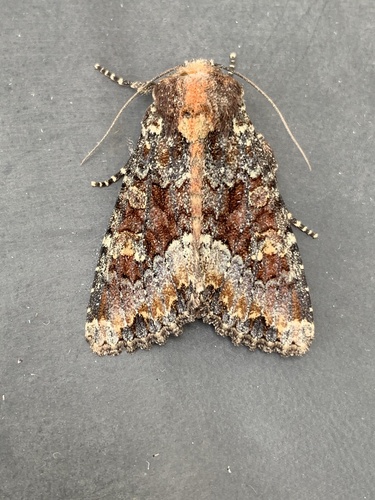
Yellow-headed Cutworm Moth
Apamea amputatrix
A master of the night, the Yellow-headed Cutworm Moth is a common but beautiful visitor to North American gardens. Known for its intricate purplish-brown wings and its role as a nocturnal pollinator, it is a staple of the summer night sky.
Quick Identification
Size
Wingspan of 40–50 mm (1.6–2.0 inches); body length approximately 20–25 mm (0.8–1.0 inches)
Colors
Forewings range from purplish-gray to reddish-brown; thorax often features orange or yellowish tufts; markings include a pale, kidney-shaped (reniform) spot
Key Features
- Distinctive yellowish or orange coloring on the head and front of the thorax
- Purplish-brown forewings with intricate pale wavy lines
- Kidney-shaped 'reniform' spot on wings often outlined in white
- Stout, hairy body typical of the Noctuidae family
When You’ll See Them
Geographic range
Where Does the Yellow-headed Cutworm Moth Live?
The Yellow-headed Cutworm Moth is native to the North American continent, where it maintains a remarkably wide and resilient distribution. Its territory stretches from the frigid reaches of the Arctic Circle in northern Canada and Alaska down through the entirety of the United States. While it is most densely populated in temperate regions and agricultural heartlands, it is equally at home in high-altitude mountain meadows and coastal suburban backyards.
Basemap © OpenStreetMap contributors
Behavior
The Yellow-headed Cutworm Moth is a nocturnal specialist, spending its daylight hours tucked away in dense vegetation or under leaf litter to avoid predators. Once dusk falls, these moths become highly active, seeking out nectar from various night-blooming flowers or fermented tree sap. While the adults are harmless pollinators, they are best known in their larval stage as 'cutworms,' which have a habit of chewing through the stems of young plants at soil level, effectively 'cutting' them down.
In a backyard setting, you will mostly likely encounter them fluttering around porch lights or garden lanterns. They are solitary creatures, though many individuals may congregate in areas with high-quality food sources or near bright artificial light. Despite their reputation as garden pests in the larval stage, the adult moths play a minor role in nocturnal pollination and serve as a vital food source for bats and nightjars.
EverydayEarth exclusive
Camera Tips
To capture high-quality images of the Yellow-headed Cutworm Moth, your best strategy is to set up your AI-powered camera near a dedicated 'mothing' station. These moths are highly attracted to ultraviolet (UV) light, so placing your camera near a blacklight or a bright LED porch light will yield the most consistent results. Ensure the camera is positioned about 12 to 18 inches away from a flat, light-colored surface (like a white sheet or fence) where the moths can land and rest, allowing the AI to focus clearly on their intricate wing patterns.
Another effective technique for trail cameras is 'sugaring.' Mix a slurry of overripe bananas, brown sugar, and a splash of beer or molasses, and paint it onto a tree trunk at eye level. Mount your camera on a neighboring tree or tripod facing the bait. This method often attracts moths that might ignore lights, providing a more natural behavioral shot as they feed. Because moths move quickly, use a fast shutter speed if your camera settings allow, and ensure your infrared (IR) flash is active for crisp black-and-white nocturnal photography.
Timing is critical for this species; they are most abundant during the mid-summer months of June through August. If you are using a backyard camera, try to minimize surrounding wind by placing the setup in a sheltered area, as moths are less likely to visit exposed stations on breezy nights. Check your camera's macro capabilities—if you can get closer without losing focus, you’ll be able to see the tiny orange scales on the 'head' area that give this moth its common name.
Frequently Asked Questions
Record Yellow-headed Cutworm Moth at your habitat
Connect a camera to start building your own species record — AI identifies every visitor automatically.