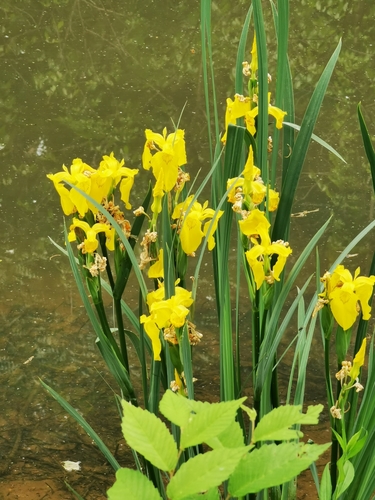
Yellow Iris
Iris pseudacorus
The Yellow Iris is a brilliant, bold dweller of the water's edge, turning muddy banks into golden corridors each spring. Known for its striking sword-shaped leaves and resilient nature, it is as much a structural masterpiece as it is a floral wonder.
Quick Identification
Size
Stands 1-1.5 meters (3-5 feet) tall; flowers are 8-10 cm (3-4 inches) wide
Colors
Bright sunny yellow petals with delicate brown or violet vein patterns on the 'falls'; deep green foliage
Key Features
- Bright yellow flowers with three drooping 'falls' and three upright 'standards'
- Long, sword-shaped leaves with a distinct, raised central mid-rib
- Forms dense, clumping mats often submerged in shallow water
- Distinctive green seed pods that resemble small bananas
When You’ll See Them
Behavior
The Yellow Iris is a vigorous perennial that behaves as a dominant force in wetland ecosystems. It spreads through a dual-threat system: heavy seed production and thick, creeping underground stems called rhizomes. In a backyard setting, it is often found lining the edges of ponds or clogging drainage ditches, where it provides excellent cover for small amphibians like frogs and salamanders, though it can eventually crowd out other plant species.
Unlike many delicate garden flowers, this species is remarkably resilient and can survive periods of drought as well as total submersion. It interacts with the local environment by acting as a filter for nutrients in the water, but its aggressive growth often requires management to prevent it from overwhelming native vegetation. While it doesn't 'move' in the traditional sense, its seasonal progression from emerging spikes to brilliant blooms and then heavy seed pods offers a fascinating visual timeline for nature observers.
EverydayEarth exclusive
Camera Tips
To capture the best images of Yellow Iris, place your camera on a low tripod or a ground mount approximately 2-3 feet from the water’s edge. Because these plants thrive in wet environments, ensure your camera housing is waterproof and positioned to avoid direct glare from the water surface. A slightly downward angle can help highlight the intricate vein patterns on the flower petals, while a side-profile shot captures the 'sword-like' height of the foliage against the water.
Since this is a stationary subject, the Yellow Iris is the perfect candidate for time-lapse photography. Set your camera to take a photo every 30 minutes during the late spring to document the 'unfolding' of the buds. For backyard pond owners, this is also a strategic location to catch 'by-catch' wildlife; many pollinators, such as bumblebees and hoverflies, frequent the yellow blooms, and the dense stalks are favorite hiding spots for frogs. Position your camera to include the base of the plant near the water line to see who is hiding in the shadows.
Pay attention to lighting conditions. Bright, midday sun can wash out the vibrant yellow of the petals. The 'golden hour'—shortly after sunrise or before sunset—provides a softer light that makes the yellow pop against the dark green leaves. If your camera allows for macro settings, try to get a close-up of the 'falls' (the drooping petals) where the nectar guides are located, as these provide stunning geometric patterns for your gallery.
Finally, consider the seasonal cycle. In late summer and autumn, the Yellow Iris produces large, green, three-angled seed pods. These are heavy and often cause the stalks to lean, creating a different aesthetic for your trail cam photos. Monitoring these pods can help you understand the plant's reproductive cycle and time your maintenance if you are trying to prevent it from spreading too aggressively in your yard.
Frequently Asked Questions
Record Yellow Iris at your habitat
Connect a camera to start building your own species record — AI identifies every visitor automatically.