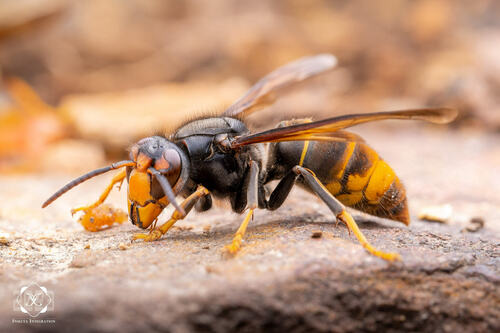
Yellow-legged Hornet
Vespa velutina
Known for its 'yellow socks' and expert hunting skills, the Yellow-legged Hornet is a master of the air. While a fascinating example of insect social structure, its expansion into Europe has made it a species of high interest for backyard naturalists and conservationists alike.
Quick Identification
Size
Workers: 20-25 mm (0.8-1 in); Queens: up to 30 mm (1.2 in); Wingspan: 35-45 mm (1.4-1.8 in)
Colors
Velvety dark brown or black thorax and abdomen; fourth abdominal segment is predominantly orange-yellow; legs have distinctive bright yellow tips.
Key Features
- Distinctive yellow tips on the legs (often called 'yellow socks')
- Dark velvety abdomen with a single prominent orange-yellow band near the rear
- Face is orange with a brownish-black top
- Slightly smaller and significantly darker than the native European Hornet
When You’ll See Them
Geographic range
Where Does the Yellow-legged Hornet Live?
Originally native to the subtropical and temperate regions of Southeast Asia, the Yellow-legged Hornet has become a high-profile traveler. It is naturally found across China, Northern India, and Thailand, but in recent decades, it has established significant invasive populations throughout Europe. Since its accidental introduction to France in 2004, it has rapidly colonized countries including Spain, Portugal, Italy, and the United Kingdom, where it thrives in both rural landscapes and densely populated suburban areas.
Basemap © OpenStreetMap contributors
Behavior
The Yellow-legged Hornet is a highly social insect that lives in large colonies numbering in the thousands. They are most famous for their specialized hunting technique known as 'hawking,' where they hover outside honeybee hives to ambush returning foragers. This species is exceptionally agile in flight and can fly backwards or hover for extended periods while tracking prey.
Unlike many other wasps, they build two types of nests: a small primary nest started by a lone queen in the spring, and a massive secondary nest—often high in the tree canopy—that can grow to the size of a beach ball by late summer. While generally not aggressive toward humans away from their nest, they will defend their colony vigorously if they perceive a threat within a few meters.
EverydayEarth exclusive
Camera Tips
To capture the Yellow-legged Hornet on camera, focus on their preferred foraging sites rather than searching for nests. During late summer and autumn, aim your camera at flowering ivy or late-season blooms like dahlias and asters. Because these hornets move quickly, use a camera with a fast trigger speed or high-frame-rate video capabilities. If you have a beehive in your garden, placing a camera on a tripod roughly 1-2 meters away from the entrance is the most reliable way to film their unique 'hawking' flight behavior.
Macro settings are essential for identifying the species accurately. Look for the 'yellow socks'—the bright yellow tips of the legs—which are the most reliable field mark. Set your camera for 4K video if possible, as this allows you to crop in later to see the specific banding on the abdomen. Since they are attracted to sugar, a small dish of fermented fruit or specialized wasp bait placed on a fence post can provide a consistent 'stage' for your camera to focus on.
Be mindful of lighting; these hornets are dark-bodied, so they can easily appear as silhouettes against a bright sky. Position your camera so the sun is behind it, illuminating the hornet's orange abdominal band and yellow legs. In late autumn, they are often more sluggish in the early morning, providing a better window for high-detail photos before they reach full flight speed in the midday sun.
Similar Species
Species that look similar or are commonly confused with Yellow-legged Hornet.
European Hornet
Larger with a much yellower abdomen and dark reddish-brown legs.
Asian Giant Hornet
Much larger (up to 5cm) with a completely orange-yellow head and broader bands.
Median Wasp
Smaller with typical yellow and black wasp patterns, lacking the specific 'yellow socks' and dark velvety thorax.
Frequently Asked Questions
Record Yellow-legged Hornet at your habitat
Connect a camera to start building your own species record — AI identifies every visitor automatically.