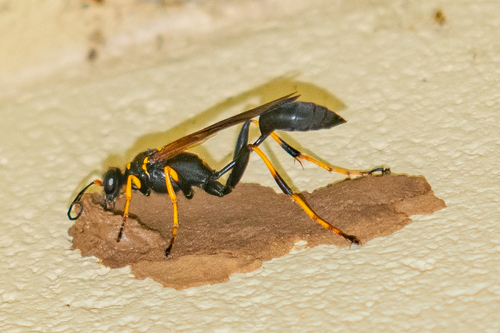
Yellow-legged Mud-dauber Wasp
Sceliphron caementarium
A master architect of the insect world, the Yellow-legged Mud-dauber Wasp is a fascinating, non-aggressive neighbor that trades spider control for a little bit of mud and a quiet corner to build.
Quick Identification
Size
24–28 mm (0.9–1.1 inches) in length; wingspan approximately 35–40 mm (1.4–1.6 inches)
Colors
Jet-black body with bright yellow markings on the thorax and the base of the abdomen. Legs are notably yellow, particularly the femora. Males and females look very similar, though females are generally larger.
Key Features
- Extremely long and thin 'thread-waist' (petiole)
- Bright yellow segments on otherwise dark legs
- Builds distinctive mud-cell nests in sheltered areas
- Non-aggressive solitary behavior
When You’ll See Them
Behavior
The Yellow-legged Mud-dauber is a solitary wasp, meaning it does not live in a colony or defend a communal hive. This makes them remarkably docile and unlikely to sting unless they are directly handled. Their lives revolve around high-stakes engineering; females spend their days scouting for mud and hunting spiders to provision their nests. You will often see them 'shivering' their wings while they work mud into their characteristic tube-shaped cells.
Unlike social wasps, they do not have a worker class. Each female is an independent contractor, building her own series of mud chambers. Once a chamber is built, she hunts for spiders, paralyzes them with a precise sting, and stuffs them into the cell. She lays a single egg on the last spider, seals the door with more mud, and leaves the larva to hatch and feed in safety. Humans typically encounter them around porches, sheds, or garden faucets where they gather materials.
EverydayEarth exclusive
Camera Tips
To capture the Yellow-legged Mud-dauber on camera, you need to focus on their three primary points of interest: the mud source, the nest site, or nectar-rich flowers. Because they are fast and relatively small, a standard trail camera should be set to its highest sensitivity. If your camera has a 'Macro' or close-focus lens attachment, use it; otherwise, place the camera at its minimum focal distance (usually 2-3 feet) from a known nest or a muddy patch of ground.
The most dramatic footage often comes from mud collection sites. Look for a leaky outdoor faucet, the edge of a birdbath, or a consistently damp garden spot. Position your camera low to the ground at a 45-degree angle. These wasps vibrate their wings rapidly while gathering mud, which creates a unique visual effect. To freeze this motion, use a fast shutter speed or high-frame-rate video (60fps or higher) if your camera supports it. Bright, direct sunlight is your friend here, as it allows the camera to use the fastest possible exposure.
If you find a nest under construction—typically in a sheltered corner of a porch or under an eave—mount your camera nearby. Mud-daubers are creatures of habit and will return to the same spot every few minutes with a new ball of mud. Use a 'Burst Mode' setting to capture the sequence of the wasp arriving and smoothing the mud into place. Since they are active during the heat of the day, ensure your camera isn't in a spot where it will overheat in the sun, though the wasp itself will be most active in the brilliance of midday.
Frequently Asked Questions
Record Yellow-legged Mud-dauber Wasp at your habitat
Connect a camera to start building your own species record — AI identifies every visitor automatically.