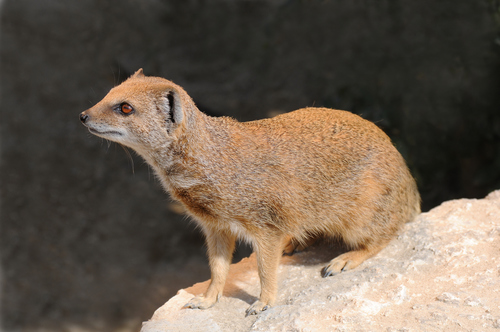
Yellow Mongoose
Cynictis penicillata
A social sun-seeker of the African plains, the Yellow Mongoose is easily recognized by its vibrant tawny coat and its signature white-tipped tail.
Quick Identification
Size
Total length approximately 510 mm (20 in); weight averages 0.45 kg (1 lb)
Colors
Tawny-yellow to reddish-orange coat; distinctive white tip on the bushy tail; southern populations are more yellow while northern ones tend toward grey or red
Key Features
- Distinctive white tip on a thick, bushy tail
- Pointed, fox-like muzzle with small rounded ears
- Slender body with four toes on the hind feet and five on the forefeet
When You’ll See Them
Geographic range
Where Does the Yellow Mongoose Live?
Native to the southern tip of the African continent, the Yellow Mongoose is a hallmark species of the semi-arid regions of Southern Africa. Its core range spans across the majority of South Africa, Namibia, and Botswana, extending into parts of southern Zimbabwe and southern Angola. It thrives in the open Highveld and the Kalahari sands, avoiding only the densest forests and the most extreme desert heartlands.
Basemap © OpenStreetMap contributors
Behavior
The Yellow Mongoose is a diurnal and highly social mammal, often living in permanent burrows that it frequently shares with meerkats and ground squirrels. Unlike many other mongoose species that are solitary, these creatures thrive in colonies of up to 20 individuals, centered around a family unit. They are sun-lovers and are most frequently seen in the early morning, basking near their burrow entrances before heading out to forage.
While they are skilled hunters, they are generally shy around humans but can become accustomed to presence in suburban fringe areas or near farmsteads. They communicate through a variety of vocalizations, including barks and purrs, and use scent marking to define their colony's territory. Their social structure is less rigid than that of meerkats, but they still benefit from the 'many eyes' approach to predator detection.
EverydayEarth exclusive
Camera Tips
To capture the best footage of a Yellow Mongoose, placement is everything. These animals are low to the ground, so mount your camera no higher than 20–30 cm (8–12 inches) off the floor. Aim the lens at a slight upward angle if you are placing it near a known burrow entrance, or keep it level if monitoring a path across a lawn or field. Because they are diurnal, ensure your camera has a fast trigger speed to catch them as they dart between cover.
The 'golden hour' just after sunrise is the best time for high-quality color photos. Yellow Mongooses love to sunbathe to warm up their metabolism. If you can locate a termite mound or a flat rock near a burrow, this is a prime spot for a camera; they will often sit upright on their haunches in these spots to survey the area for predators. This upright 'sentinel' pose makes for an iconic photograph.
In a backyard setting, you don't necessarily need bait, as their natural curiosity and insect-hunting drive will bring them through. However, if you are trying to encourage them to linger in front of the lens, a small amount of wet cat food or a few mealworms can work wonders. Be mindful that this might also attract domestic pets or nocturnal scavengers. Use a high frame rate for video, as their movements are incredibly quick and jittery.
Frequently Asked Questions
Record Yellow Mongoose at your habitat
Connect a camera to start building your own species record — AI identifies every visitor automatically.