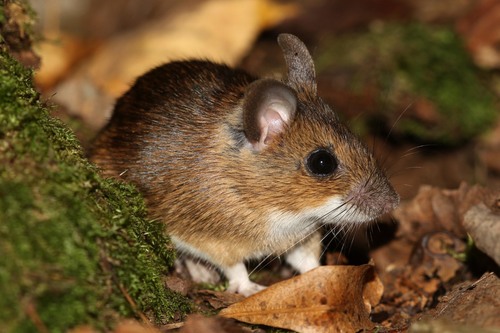
Yellow-necked Field Mouse
Apodemus flavicollis
A golden-collared acrobat of the night, the Yellow-necked Field Mouse is a master of the treetops and a frequent visitor to woodland gardens. With its oversized ears and incredible leaping ability, it's one of the most charismatic mammals you can discover in the dark.
Quick Identification
Size
Head and body length: 9-13 cm (3.5-5 in); Tail length: 9-13.5 cm (3.5-5.3 in); Weight: 25-50g (0.9-1.8 oz)
Colors
Rich golden-brown to ginger on the back with a stark, snow-white belly. Features a signature unbroken band of yellow fur across the neck/chest.
Key Features
- Distinct unbroken yellow collar stretching between front legs
- Large, prominent ears and bulging black eyes
- Long, hairless tail usually longer than the body
- Whiter underside compared to its Wood Mouse cousins
When You’ll See Them
Behavior
The Yellow-necked Field Mouse is a high-energy, acrobatic powerhouse of the rodent world. Unlike many other small mammals that stick to the ground, this species is an exceptional climber and can often be seen leaping through the branches of trees or scurrying along the rafters of outbuildings. They are notably more aggressive and territorial than the more common Wood Mouse, and their larger size often gives them the upper hand when competing for food sources.
These mice are legendary scatter-hoarders. They spend much of the autumn gathering large quantities of seeds and nuts, which they cache in various locations like hollow logs, bird boxes, or even wall cavities to survive the winter. While they are generally shy of humans, they are known to enter rural homes and sheds when the temperature drops, seeking both warmth and stored food. In these environments, they can be surprisingly bold, though they remain strictly nocturnal.
Socially, they are somewhat solitary but may share nests during particularly cold spells to conserve heat. Because they are a reservoir for certain viruses like the Dobrava hantavirus, it is best to observe them through your camera lens rather than handling them, though the risk to casual observers in a garden setting is extremely low.
EverydayEarth exclusive
Camera Tips
To capture the Yellow-necked Field Mouse on camera, you need to think vertically. While most people set their cameras at ground level, this mouse is just as likely to appear on a fence rail, a low tree branch, or the roof of a bird table. Position your camera about 30-60 cm (1-2 feet) above the ground, aimed at a horizontal 'travel lane' such as a fallen log or the top of a stone wall. These features act as natural highways for mice moving through your garden.
The biggest challenge with this species is their speed. They move in frantic bursts of energy, which can result in blurry 'ghost' images on slower cameras. For the best results, use a camera with a high trigger speed (0.3 seconds or less) and set it to capture short 10-15 second video clips. This allows you to see their behavior and, crucially, gives you a better chance of spotting the yellow collar that identifies them. If your camera has a 'close focus' or 'macro' setting, now is the time to use it, as these mice are small subjects.
Baiting is highly effective but requires a specific strategy. Instead of loose seeds that a mouse will grab and whisk away in half a second, use a 'sticky' bait like peanut butter or a smear of suet mixed with birdseed. Smear this onto a textured log directly in front of the camera lens. This forces the mouse to stay in place and lick the bait, providing a stable, high-quality shot. Position the bait so the mouse is likely to stand on its hind legs or turn its chest toward the camera, which is the best way to confirm the unbroken yellow band around its neck.
During the winter, if you have a garden shed or greenhouse, try placing a camera inside near the rafters or along the base of the walls. Yellow-necked Field Mice frequently move indoors during the cold months, and the controlled environment of a shed can result in some of the clearest, most intimate footage you'll ever get of this species. Just ensure your camera's infrared flash isn't too close to a reflective surface, which can overexpose the white belly of the mouse.
Similar Species
Species that look similar or are commonly confused with Yellow-necked Field Mouse.
Frequently Asked Questions
Record Yellow-necked Field Mouse at your habitat
Connect a camera to start building your own species record — AI identifies every visitor automatically.