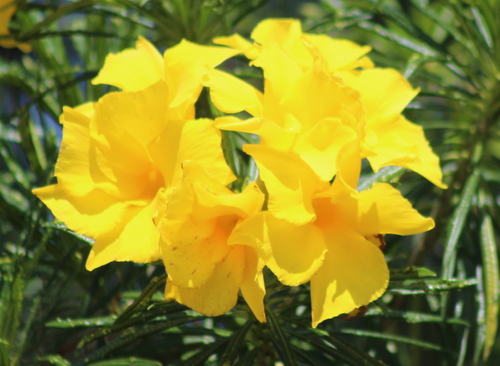
Yellow Oleander
Cascabela thevetioides
A stunning tropical evergreen that illuminates backyards with its funnel-shaped sunshine-yellow blooms. The Yellow Oleander is a vibrant pollinator magnet that brings constant movement and color to any sun-drenched landscape.
Quick Identification
Size
A large shrub or small tree reaching 10-20 feet (3-6 meters) in height with a spread of 8-12 feet (2.5-3.5 meters).
Colors
Brilliant lemon-yellow to golden-orange funnel-shaped flowers; glossy, deep-green lance-shaped leaves; green fruit that turns black when ripe.
Key Features
- Large funnel-shaped yellow flowers 2-3 inches long
- Long, narrow leaves with a prominent midrib
- Glossy evergreen foliage
- Produces small, angular green fruits that ripen to black
- All parts contain a milky white, toxic sap
When You’ll See Them
Behavior
The Yellow Oleander is a fast-growing tropical evergreen that functions as a cornerstone of many sun-drenched backyard ecosystems. While it is primarily stationary as a plant, it exhibits dynamic growth and blooming patterns, often flowering year-round in warmer climates. It is highly valued for its ability to withstand heat and poor soil, making it a common sight in suburban landscaping and along forest edges.
Ecologically, this species acts as a hub for local biodiversity. Its nectar-rich flowers are a primary draw for various pollinators, including large bees and butterflies. However, it is important to note its defensive behavior; the entire plant is highly toxic to mammals and most insects due to the presence of cardiac glycosides. This toxicity protects it from being eaten by deer or other herbivores, allowing it to maintain its lush appearance throughout the seasons.
EverydayEarth exclusive
Camera Tips
Capturing the Yellow Oleander on your EverydayEarth camera is less about the plant’s movement and more about the incredible wildlife it attracts. To get the best shots, mount your camera on a tripod or a nearby fence post at a height of 4 to 6 feet, aiming directly at a cluster of fresh blooms. Because these flowers are highly attractive to hummingbirds and large butterflies like Sulphurs and swallowtails, using a 'Fast Motion' or 'High Sensitivity' trigger setting is essential to catch these quick-moving visitors in action.
For a truly unique perspective, set your camera to time-lapse mode. Yellow Oleander flowers have a fascinating lifecycle, often opening fully in the morning and lasting for just a few days. Setting an interval of one frame every 5-10 minutes over a 48-hour period will allow you to see the rhythmic 'pulse' of the plant as flowers bloom and wither. Ensure the camera is positioned so that the sun is behind or to the side of the lens; direct midday sun can wash out the bright yellow petals, while side-lighting emphasizes the waxy texture of the leaves.
Since this plant is often used as a privacy screen, cameras can be tucked into the foliage to monitor 'hidden' wildlife. Many small birds use the dense, toxic branches as a safe nesting site because predators like cats or raccoons are often deterred by the plant's reputation. If you are positioning a camera near the fruit, keep it active during the evening. While toxic to humans, some specialized fruit-eating birds may visit to investigate the ripening pods.
Lastly, consider the weather. The Yellow Oleander looks spectacular during or immediately after a rainstorm. The glossy leaves and vibrant yellow bells catch water droplets beautifully. If your camera has a macro or close-focus capability, aim for a single blossom to capture the intricate details of the flower's interior, where pollinators crawl to reach the nectar. Always remember to wear gloves if you are trimming branches near your camera, as the milky sap is a skin irritant.
Frequently Asked Questions
Record Yellow Oleander at your habitat
Connect a camera to start building your own species record — AI identifies every visitor automatically.