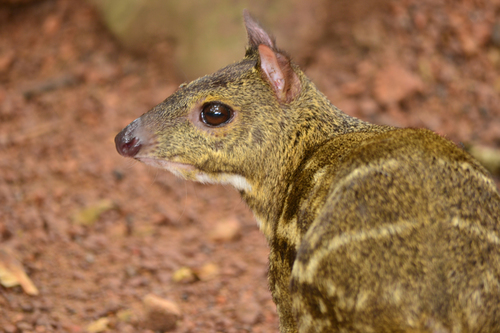
Yellow-striped Chevrotain
Moschiola kathygre
A miniature marvel of the Sri Lankan rainforest, the Yellow-striped Chevrotain is an ancient 'mouse-deer' known for its striking golden markings and secretive lifestyle. Rarely seen by the naked eye, this tiny ungulate is a prized capture for any backyard wildlife enthusiast.
Quick Identification
Size
Head-body length of 43-51 cm (17-20 in); weight ranges from 2.1-4.5 kg (4.6-10 lbs).
Colors
Rich olive-brown coat with four to five rows of distinct yellow stripes and spots along the flanks; underparts are pale or white.
Key Features
- Distinctive yellow horizontal stripes on the sides
- Diminutive size, roughly the height of a house cat
- Males lack antlers but possess elongated, tusk-like canine teeth
- Extremely slender legs with four toes on each foot
When You’ll See Them
Behavior
The Yellow-striped Chevrotain, often affectionately called the 'mouse-deer,' is a shy and solitary creature that acts as a living fossil, representing an ancient lineage of hoofed mammals. They are remarkably nervous animals, relying on their keen sense of hearing and smell to detect threats. When spooked, they don't run in a straight line but rather zigzag through dense undergrowth, sometimes even freezing in place to let their camouflaged coat blend into the forest floor.
Socially, these chevrotains are rarely seen in groups, usually preferring to forage alone except during the mating season. They are highly territorial, and males will use their sharp, tusk-like canines to defend their patch of forest from rivals. While they are generally quiet, they may emit soft bleats or whistle-like sounds when communicating or in distress. Interactions with humans are rare due to their nocturnal habits and preference for dense cover.
EverydayEarth exclusive
Camera Tips
Capturing a Yellow-striped Chevrotain on camera requires a strategic approach because of their small stature and skittish nature. You must place your camera much lower than you would for standard deer; aim for a height of about 6 to 10 inches (15-25 cm) off the ground. Angle the lens slightly upward if the terrain is uneven, ensuring you have a clear line of sight through the low-lying ferns and leaf litter where these animals spend 100% of their time.
Look for 'micro-trails'—tiny, narrow paths through the undergrowth—or areas near the base of fruiting trees. If you have wild fruit trees in your backyard or near your trail, these are goldmines for activity. They are particularly fond of fallen, soft-fleshed fruits. Unlike larger mammals, they won't trigger cameras set to 'low' sensitivity, so make sure your PIR (Passive Infrared) sensor is set to its highest sensitivity level to catch their quick, dainty movements.
Since they are most active during the twilight hours and throughout the night, the quality of your camera's infrared (IR) flash is critical. We recommend using a 'No-Glow' or 'Black IR' flash to avoid startling the animal with a visible red glow, which might cause them to bolt and never return to that spot. Set your camera to 'Burst Mode' with 3-5 photos per trigger; they move with a characteristic jerky motion, and having multiple frames increases your chance of getting one perfectly clear shot of their yellow stripes.
Patience is your best friend with this species. They are highly sensitive to human scent, so wear gloves when handling your equipment and try to minimize visits to the camera site. During the rainy season in Sri Lanka’s wet zone, ensure your camera housing is well-protected against high humidity, as these 'wet-zone' specialists are most active when the ground is damp and fruit is plentiful.
Frequently Asked Questions
Record Yellow-striped Chevrotain at your habitat
Connect a camera to start building your own species record — AI identifies every visitor automatically.