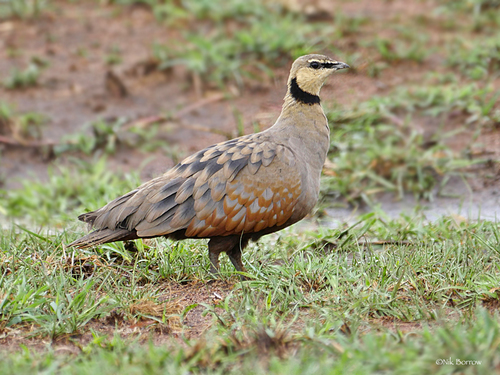
Yellow-throated Sandgrouse
Pterocles gutturalis
The Yellow-throated Sandgrouse is the golden-bibbed survivor of the African plains. Renowned for its incredible daily flights to water and its unique ability to carry moisture in its feathers, it is a master of desert adaptation.
Quick Identification
Size
Length: 29–33 cm (11.5–13 in); Wingspan: 55–65 cm (21–25 in); Weight: 340–410 g (12–14.5 oz)
Colors
Males have an olive-yellow face and throat, a black chest band, and mottled brown-grey wings. Females are more cryptically colored with buff and dark brown spotting throughout.
Key Features
- Distinctive yellow throat and face (males)
- Narrow black 'necklace' across the upper chest
- Stocky, pigeon-like body with pointed wings and tail
- Orangish-buff underparts
When You’ll See Them
Behavior
Perhaps their most fascinating behavior involves their reproductive strategy. To ensure their chicks stay hydrated in the searing heat of the African plains, the males possess specialized feathers on their bellies. These feathers act like sponges, allowing the father to soak up water at a distant pool and fly it back to the nest—sometimes over distances of 30 kilometers—where the chicks 'milk' the water from his plumage.
EverydayEarth exclusive
Camera Tips
Because sandgrouse are naturally skittish and prone to sudden flight, use a camera with a fast trigger speed. If your AI-powered camera allows for custom detection zones, focus the trigger area on the muddy edge of the water where the birds are most likely to land. They rarely land directly in the water; instead, they touch down a few meters away and walk tentatively toward the edge. Positioning your camera to capture this approach path will give you more footage of them in motion. If you are setting this up in a large backyard or farm, a ground-level birdbath or a simple shallow pan of water can act as a powerful lure in dry weather.
Lighting is a critical factor for this species. Since their primary activity window is early morning, try to place your camera with the sun at its back (facing west or south-west). This 'golden hour' light will saturate the yellow and olive tones of the male's plumage. Avoid placing cameras in tall grass, as the wind-blown blades will cause hundreds of false triggers. Instead, look for 'hard-pan' soil or areas with very short, grazed grass. Finally, consider using a high-frame-rate setting (60fps or higher) if you want to capture the spectacular sight of a flock taking off simultaneously, which is one of the most iconic displays of this species.
Similar Species
Species that look similar or are commonly confused with Yellow-throated Sandgrouse.
Double-banded Sandgrouse
Smaller than the Yellow-throated, the male has a distinct black and white band across its forehead and lacks the solid yellow throat.
Burchell's Sandgrouse
Features white spots across its entire body, giving it a speckled appearance rather than the smooth olive and yellow tones of the Yellow-throated.
Frequently Asked Questions
Record Yellow-throated Sandgrouse at your habitat
Connect a camera to start building your own species record — AI identifies every visitor automatically.