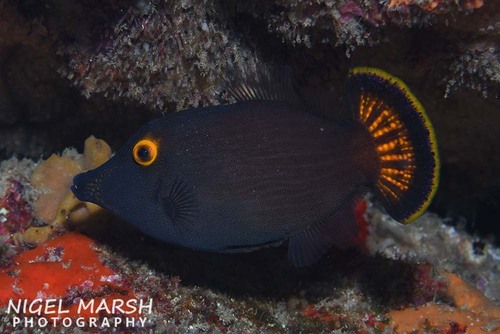
Yelloweye Leatherjacket
Pervagor alternans
A master of reef camouflage with a striking golden gaze, the Yelloweye Leatherjacket is a vibrant hidden gem of the South Pacific's rocky shores.
Quick Identification
Size
Typically reaches 14–16 cm (5.5–6.3 inches) in length.
Colors
Mottled brown to reddish-orange body with fine blue spots or lines; distinctive bright yellow ring around the eye; bright orange to red tail fin.
Key Features
- Bright yellow ring surrounding the eye
- Large, retractable first dorsal spine above the eye
- Mottled brownish body with iridescent blue speckles
- Bright orange or reddish caudal fin
When You’ll See Them
Geographic range
Where Does the Yelloweye Leatherjacket Live?
The Yelloweye Leatherjacket is native to the Southwestern Pacific Ocean. It is primarily found along the eastern coast of Australia, with its core range extending from southern Queensland down through New South Wales. Its distribution also reaches offshore to Lord Howe Island and eastward to the waters of New Caledonia.
Basemap © OpenStreetMap contributors
Behavior
The Yelloweye Leatherjacket is a shy and relatively secretive resident of rocky reefs and seagrass meadows. Unlike more boisterous reef fish, this species prefers to stay close to cover, often hovering near crevices or within the swaying blades of kelp and seagrass. They move with a delicate, undulating motion using their dorsal and anal fins, which allows them to maneuver precisely in tight spaces while searching for food.
These fish are generally solitary or found in pairs. They are highly territorial regarding their preferred hiding spots and will use their 'trigger'—a thickened first dorsal spine—to wedge themselves into rock cracks when threatened, making it nearly impossible for predators to pull them out. To humans, they are curious but cautious, usually retreating if approached too quickly.
EverydayEarth exclusive
Camera Tips
To capture the Yelloweye Leatherjacket, you will need an underwater action camera or a trail camera in a specialized waterproof housing. Since these fish are often found in shallow coastal areas, mounting your camera on a weighted tripod near a jetty pylon or a rocky overhang is the most effective strategy. Aim the lens at a 45-degree angle toward the reef floor to catch them as they forage for small invertebrates.
Because they are shy, using a 'bait station' is highly recommended. A small mesh bag filled with crushed shellfish or oily fish scraps tied within the camera's field of view will draw them out from their hiding spots. Ensure the camera is positioned at least 30-50 cm away from the bait to allow the AI to focus correctly on the fish's distinctive yellow eye and mottled patterns.
Lighting is crucial for bringing out the iridescent blue spots on their flanks. In shallow water (under 5 meters), natural sunlight is usually sufficient between 10 AM and 2 PM. If you are placing the camera in deeper or shaded areas, a small, continuous underwater video light will help the camera sensor maintain a high enough shutter speed to freeze the movement of their delicate fins.
Set your camera to record short video clips (15-30 seconds) rather than still photos. The Yelloweye Leatherjacket has a unique swimming style, and video is often the only way to distinguish it from other similar-looking filefish. If your camera supports it, use a 'Macro' or close-focus setting, as these fish are small and the best footage comes from close-up encounters.
Frequently Asked Questions
Record Yelloweye Leatherjacket at your habitat
Connect a camera to start building your own species record — AI identifies every visitor automatically.