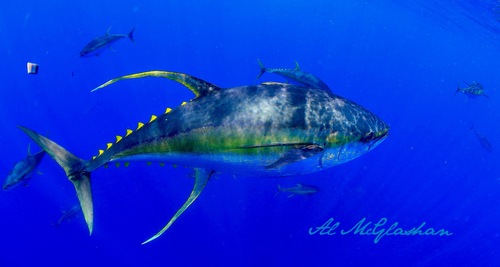
Yellowfin Tuna
Thunnus albacares
The athlete of the open ocean, the Yellowfin Tuna is a flash of gold and silver in the deep blue. Known for its incredible speed and striking sickle-shaped fins, it is one of the world's most impressive pelagic species.
Quick Identification
Size
Typically 60-150 cm (24-60 in) but can reach 2.4 meters (7.9 feet); weights range from 1.3 to 200 kg (3 to 440 lbs).
Colors
Dark metallic blue back transitioning to silver on the belly; distinctive bright yellow second dorsal fin, anal fin, and finlets.
Key Features
- Extremely long, sickle-shaped yellow dorsal and anal fins
- Series of bright yellow finlets along the tail ridge
- Metallic dark blue back with iridescent silver sides
- Streamlined, torpedo-shaped body for high-speed swimming
When You’ll See Them
Behavior
Yellowfin Tuna are among the fastest and most energetic predators in the open ocean. They are highly migratory, often traveling thousands of miles across tropical and subtropical waters. These fish are known for their schooling behavior, frequently grouping by size. Interestingly, they often associate with other species, such as skipjack tuna, and in some regions, they are famously known for swimming beneath schools of dolphins.
They are opportunistic hunters that rely on their incredible speed and keen eyesight to ambush prey. Because they are cold-blooded but have a specialized internal heat-exchange system, they can maintain a body temperature higher than the surrounding water, allowing them to remain highly active in various depths. While they spend much of their time in the sunlit epipelagic zone, they are capable of making deep dives into cooler waters to forage.
EverydayEarth exclusive
Camera Tips
Capturing the Yellowfin Tuna requires a specialized underwater setup, as they never venture into shallow backyard environments. If you are deploying an underwater 'drop camera' or using an ROV near a coastal shelf, depth and lighting are your two biggest hurdles. Focus your efforts in the top 100 feet of the water column where sunlight is most prevalent. Use a high-quality waterproof housing and consider a polarized lens filter to reduce the glare from the sun reflecting off the surface when filming looking upward.
Because Yellowfin move at incredible speeds, standard 24 or 30 fps video will often result in a silver blur. Set your camera to at least 60 fps (or 120 fps if available) to ensure you can freeze the action and identify the diagnostic long yellow fins. If you are using a stationary camera, try mounting it to a floating structure or a 'Fish Aggregating Device' (FAD), as tuna are naturally drawn to objects floating in the open sea. This increases the chances of the fish loitering within the frame rather than just swimming through.
To attract them to your lens, use a 'chum' bag filled with oily fish like sardines or anchovies. The scent trail will draw them in from a distance. Position the camera about 5-10 feet away from the bait bag to ensure you capture the whole fish in the frame. If you are filming in deeper water where the colors start to fade to gray, you must use high-lumen external video lights to reveal the stunning 'yellow' in the yellowfin, otherwise, they will look like a generic silver fish on camera.
Similar Species
Species that look similar or are commonly confused with Yellowfin Tuna.
Frequently Asked Questions
Record Yellowfin Tuna at your habitat
Connect a camera to start building your own species record — AI identifies every visitor automatically.