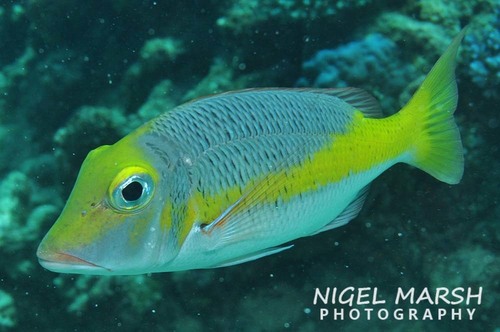
Yellowtail Emperor
Lethrinus atkinsoni
With its sun-drenched fins and curious gaze, the Yellowtail Emperor is a master of the Pacific coral reefs. This 'tricky snapper' is a favorite for underwater photographers looking to capture the vibrant life of the sea floor.
Quick Identification
Size
Typically 30-35 cm (12-14 in) in length, reaching a maximum of 50 cm (20 in); weight ranges from 0.5-1.5 kg (1.1-3.3 lbs).
Colors
Tan to yellowish-brown body with subtle dark reticulated patterns; fins are notably yellow to orange, with the tail (caudal fin) being a bright, distinct yellow.
Key Features
- Bright yellow caudal fin
- Scaleless cheek area
- Steep head profile with large eyes
- Yellowish-orange pectoral and anal fins
- Subtle reticulated or 'net-like' pattern on scales
When You’ll See Them
Geographic range
Where Does the Yellowtail Emperor Live?
The Yellowtail Emperor is a signature species of the Western Pacific Ocean's tropical waters. Its native range spans from the rich biodiversity of Indonesia and the Philippines, northward to the Ryukyu Islands of southern Japan, and southward to the northern coasts of Australia and the Great Barrier Reef. It is also widely distributed across the archipelagos of Oceania, including the Solomon Islands, Fiji, and as far east as the Tuamotu Islands.
Basemap © OpenStreetMap contributors
Behavior
The Yellowtail Emperor is a sophisticated bottom-dweller that balances curiosity with a high degree of caution. Often referred to as the 'tricky snapper' by coastal communities, this fish is known for its ability to deftly navigate coral reef structures while avoiding predators and fishers alike. They are primarily solitary hunters but can occasionally be seen in small, loose aggregations, especially in areas where food is abundant or during certain tidal movements.
During the day, they are active foragers, using their powerful muzzles to sift through sand and rubble at the base of reefs. They have a fascinating interaction with their environment, often following larger 'sand-stirrers' like rays to snatch up any displaced prey. When they aren't feeding, they hover effortlessly in the water column or hide within the shadows of large coral heads to avoid the gaze of larger reef sharks.
EverydayEarth exclusive
Camera Tips
To capture the Yellowtail Emperor, you will need a dedicated underwater camera setup or a waterproof housing for your trail camera. Position the camera on a weighted tripod or a stable sandy patch just at the edge of a coral reef or a 'bommie.' Because these fish are bottom-feeders, angling the lens slightly downward toward the sand-rubble interface will capture them in their most natural state: hunting for buried invertebrates.
Using a 'bait station' is the most effective way to draw them into the frame. A mesh burley bag filled with crushed shellfish, shrimp, or oily fish scraps works wonders. Secure the bag to a fixed point about 1 to 2 metres in front of the lens. The scent will drift with the current, attracting Emperors from down-current. Since they are diurnal, ensure your camera's high-speed trigger is active during daylight hours when light penetration is at its peak for the best color reproduction of their yellow fins.
If you are setting up near a dock or pier in a tropical area, watch for tidal changes. Yellowtail Emperors often move into shallower reef flats during high tide to feed. Aim to have your camera active during the 'incoming' tide for the highest chance of activity. For those using AI-powered detection, training the system to recognize 'yellow' or 'oval fish shapes' can help filter out the movement of swaying seagrass or smaller, less colorful baitfish that might otherwise trigger the sensor unnecessarily.
Similar Species
Species that look similar or are commonly confused with Yellowtail Emperor.
Frequently Asked Questions
Record Yellowtail Emperor at your habitat
Connect a camera to start building your own species record — AI identifies every visitor automatically.