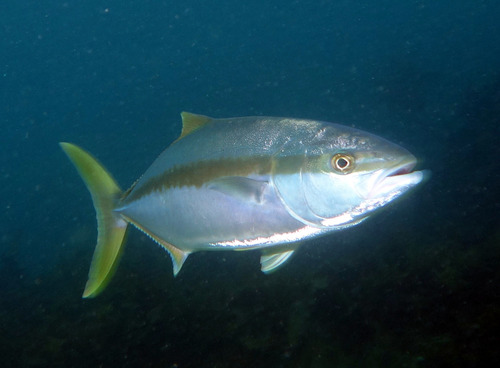
Yellowtail Kingfish
Seriola lalandi
The ultimate athlete of the Southern Ocean, the Yellowtail Kingfish is a vibrant, high-speed predator that thrives in the surf and reef. Its golden stripe and powerful build make it one of the most recognizable and respected residents of the coast.
Quick Identification
Size
Typically 60-100 cm (24-40 in) and 5-15 kg (11-33 lbs), though they can reach up to 1.8 m (71 in) and 70 kg (154 lbs).
Colors
Metallic blue-green upper body transitioning to a silvery-white belly, with a signature bright yellow horizontal stripe and yellow fins.
Key Features
- Streamlined, torpedo-shaped body
- Bright yellow caudal fin (tail)
- Distinct yellow stripe running from snout to tail
- Dark diagonal bar through the eye
When You’ll See Them
Behavior
Yellowtail Kingfish are high-octane pelagic predators known for their incredible speed and stamina. They are highly social, particularly when young, forming large, coordinated schools that patrol rocky reefs, kelp forests, and offshore islands. These schools work together to corral baitfish into tight balls before taking turns darting through the mass to feed.
As they reach maturity, larger individuals often become more solitary or travel in small groups known as "wolf packs." They are remarkably inquisitive and are known to approach divers or boats to investigate movement in the water. Despite their power, they are not considered aggressive toward humans, though their sheer size and speed make them an awe-inspiring sight in their natural habitat.
EverydayEarth exclusive
Camera Tips
Capturing the Yellowtail Kingfish requires a specialized approach, as these are entirely aquatic animals. If you have a waterfront property or access to a private dock, the best setup is a submersible action camera or a dedicated underwater trail camera mounted to a piling or a weighted tripod. Position the camera at a depth of 2 to 4 meters, facing away from the structure into the current where Kingfish are likely to patrol.
Because Kingfish are visual hunters attracted to movement and flash, you can significantly increase your capture rate by using a "teaser." Suspend a shiny metal flasher or a few highly reflective lures about 2 meters in front of the camera lens. The natural movement of the tide will cause these to shimmer, mimicking a small school of baitfish and drawing curious Kingfish into the frame. For the best clarity, ensure you are filming during a high tide when the water is typically at its clearest.
Lighting is your biggest challenge underwater. Aim to record during midday when the sun is directly overhead to maximize natural light penetration, or use a camera with a high-quality low-light sensor if filming during their peak dawn and dusk activity. Set your camera to a high frame rate—at least 60 frames per second—to capture their lightning-fast strikes without motion blur. If your camera supports it, use a wide-angle lens to account for the Kingfish's large size and erratic swimming patterns.
Similar Species
Species that look similar or are commonly confused with Yellowtail Kingfish.
Frequently Asked Questions
Record Yellowtail Kingfish at your habitat
Connect a camera to start building your own species record — AI identifies every visitor automatically.