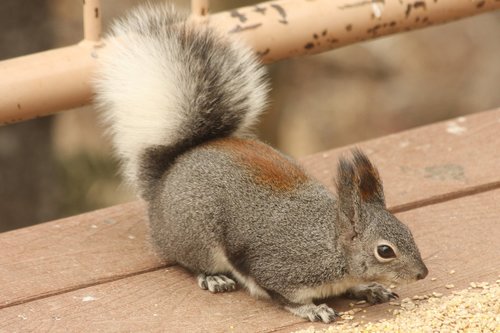
Abert's Squirrel
Sciurus aberti
With their striking tasseled ears and acrobatic forest maneuvers, Abert's Squirrels are the charismatic crown jewels of the Ponderosa pine ecosystem. Discover how to spot these specialized climbers in your high-country backyard.
Quick Identification
Size
Total length of 46–58 cm (18–23 in); weight typically between 600–950 g (1.3–2.1 lb)
Colors
Steel-gray body with a distinct reddish-brown (rufous) patch on the back, contrasting white underparts, and dark ear tufts
Key Features
- Prominent 1-inch long ear tufts or 'tassels'
- Bright rufous patch on the mid-back
- Bushy tail with white-tipped hairs
- Strict association with Ponderosa pine trees
When You’ll See Them
Geographic range
Where Does the Abert's Squirrel Live?
Native to the rugged landscapes of North America, Abert's Squirrel is a signature resident of the Southern Rocky Mountains. Its core range spans the high-country forests of the Southwestern United States—primarily Arizona, New Mexico, and Colorado—extending southward into the northern Sierra Madre Occidental of Mexico. Because of their strict reliance on specific pine species, their distribution is naturally fragmented into 'islands' of suitable high-altitude habitat across the Four Corners region.
Basemap © OpenStreetMap contributors
Behavior
Abert’s Squirrels are highly specialized arboreal mammals that have evolved a symbiotic relationship with Ponderosa pine trees. Unlike many other North American squirrels, they do not store large caches of nuts underground. Instead, they are active year-round, spending their time foraging in the canopy or on the forest floor for specific parts of the pine tree and associated fungi. They are primarily solitary outside of the breeding season, which occurs in late spring and early summer.
These squirrels are exceptionally agile climbers, using their large, tufted ears and broad tails for balance as they leap between branches. While they are generally shy around humans, they can become accustomed to backyard settings if those backyards provide the mature pine habitat they require. Their daily routine is strictly diurnal, typically emerging shortly after sunrise to begin a day of feeding and grooming before retiring to their spherical leaf nests, called dreys, positioned high in the tree canopy.
EverydayEarth exclusive
Camera Tips
To capture the elusive Abert’s Squirrel, your camera placement must focus on their 'anchor' trees—specifically mature Ponderosa pines. Look for 'feeding sign' on the forest floor, which includes clipped pine twigs and stripped branch tips. Mount your camera approximately 3 to 5 feet up the trunk of a large pine, angled slightly downward toward the base. This captures them as they descend to forage for truffles or move between trees on the ground.
While Abert’s Squirrels are picky eaters, you can increase your capture rate by using 'lure logs.' Place a fallen log within the camera's field of view and sprinkle it with pine nuts or high-quality black oil sunflower seeds. They are also attracted to salt and mineral blocks, especially in the spring. If you have a bird feeder, position your camera nearby, as they will often visit to scavenge fallen seeds, though they rarely compete directly with smaller squirrels at the feeder itself.
For the best photographic results, try to capture them during the winter months. Their iconic ear tufts are most prominent during the colder season (often disappearing in mid-summer), and their gray fur provides a stunning contrast against snowy branches. Use a fast shutter speed or a multi-shot burst mode, as these squirrels are incredibly twitchy and can move out of frame in a fraction of a second. If your camera has a 'Hybrid Mode,' use it to capture 10-second video clips, which will reveal their unique tail-flicking communication behavior.
Similar Species
Species that look similar or are commonly confused with Abert's Squirrel.
Frequently Asked Questions
Record Abert's Squirrel at your habitat
Connect a camera to start building your own species record — AI identifies every visitor automatically.