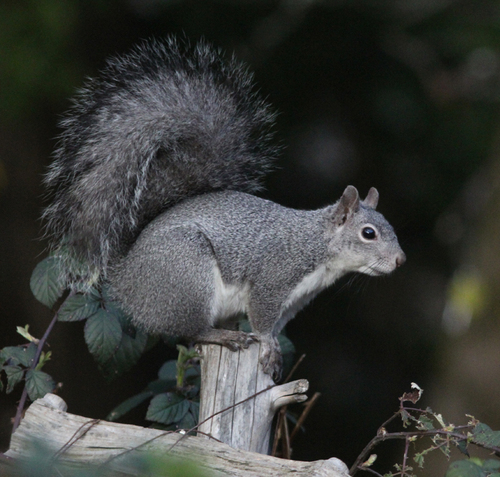
Western Gray Squirrel
Sciurus griseus
The 'silver ghost' of the Western woods, this elegant squirrel is known for its spectacular plume-like tail and shy demeanor. Larger and more elusive than its urban cousins, it is a master of the oak-conifer canopy.
Quick Identification
Size
20–24 inches (50–60 cm) total length; Weight 1.3–2.2 lbs (600–1000 g)
Colors
Uniform salt-and-pepper silver-gray upper body; stark white underbelly; large, bushy gray tail with white-tipped hairs
Key Features
- Extraordinarily large and bushy plume-like tail with white edges
- Solid silver-gray coat with no reddish or brown tones
- Stark white underparts and white-rimmed ears
- Significantly larger than the invasive Eastern Gray Squirrel
When You’ll See Them
Behavior
The Western Gray Squirrel is the shy, refined cousin of the more common urban squirrels. Unlike the bold Eastern species that often beg for scraps, the Western Gray is a true forest dweller that prefers the safety of high canopy cover. They are masters of the trees, spending much of their lives leaping between branches with incredible agility. They are primarily solitary, only coming together briefly during the winter mating season, and they maintain a strictly diurnal schedule, retreating to large nests called dreys made of sticks and moss as the sun sets.
These squirrels are vital to their ecosystem as forest regenerators. They are famous for 'scatter-hoarding,' a behavior where they bury individual acorns and seeds in hundreds of different locations across the forest floor. Because they inevitably forget where some of these prizes are hidden, they effectively plant the next generation of oak and pine trees. While they can be found in suburban backyards, they usually only visit properties that offer mature trees and a sense of quiet security.
EverydayEarth exclusive
Camera Tips
To capture the perfect shot of a Western Gray Squirrel, height is your best friend. While many backyard mammals are easily filmed at ground level, this species is semi-arboreal and feels most comfortable when slightly elevated. Mount your AI-powered camera 5 to 8 feet up on a mature oak or pine tree, angled slightly downward toward a sturdy, horizontal 'highway' branch. These squirrels often use the same aerial paths to navigate through your yard, and catching them mid-stride on a branch provides a much more naturalistic image than a ground-level shot.
If you want to lure them into a specific frame, skip the birdseed and go straight for high-quality unsalted walnuts or hazelnuts. Instead of scattering them on the grass, try wedging a few nuts into the crevices of tree bark or placing them inside a small, natural-looking hollowed log within the camera's field of view. This encourages the squirrel to stay in the frame and work for the food, giving your camera more time to trigger and capture multiple angles of their magnificent 'banner-tail.'
Since Western Gray Squirrels are faster and more skittish than other backyard visitors, camera settings are crucial. Set your device to a high-sensitivity motion trigger and a short 'cool-down' period between captures. If your camera supports it, a 10-15 second video clip is often better than a still photo, as it allows you to see the fluid movement of that massive tail. Early morning light is the most flattering for their silver fur, so ensure your camera isn't facing directly into the rising sun, which can wash out their subtle color gradients.
Be patient and minimize human activity near the camera site. Unlike Fox squirrels, the Western Gray may abandon an area for several hours if they detect too much movement or noise. In the autumn months, focus your camera efforts near the base of large oaks where they are likely to be digging. Their caching behavior provides excellent 'action' shots as they vigorously pat down the soil over their buried winter treasures.
Similar Species
Species that look similar or are commonly confused with Western Gray Squirrel.
Frequently Asked Questions
Record Western Gray Squirrel at your habitat
Connect a camera to start building your own species record — AI identifies every visitor automatically.