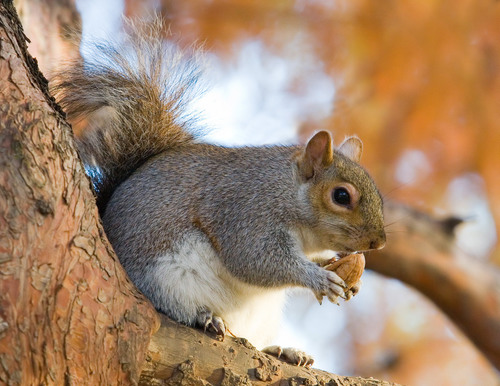
Eastern Gray Squirrel
Sciurus carolinensis
The clever architect of the eastern forests, the Eastern Gray Squirrel is a master of memory and agility. From its acrobatic leaps to its vital role in tree dispersal, this backyard favorite is a testament to the resilience of North American wildlife.
Quick Identification
Size
Total length of 38–52 cm (15–20 in); tail length of 15–25 cm (6–10 in); weight ranges from 400–600 g (0.9–1.3 lbs)
Colors
Predominantly 'salt-and-pepper' gray fur with a brownish wash on the face, ears, and paws; distinct white or light gray underbelly; tail hairs are tipped with white
Key Features
- Large bushy tail with white-tipped fringe
- White or cream-colored underbelly
- Pointed ears without prominent tufts
- Agile, slender body built for climbing
When You’ll See Them
Sightings on EverydayEarth
Feb 19, 2026
A black morph Eastern Gray Squirrel is perched on the edge of the bird feeder tray, actively foraging. It uses its paws to sift through the sunflower seeds and other grains, occasionally sniffing the tray as it moves its head close to the camera lens.
May 9, 2026
An Eastern Gray Squirrel is busily tending to its nest inside the wooden box. It moves vigorously, rearranging a mix of white nesting fluff and thin twigs to refine the internal structure.
Jul 25, 2026
An Eastern Gray Squirrel is seen foraging on the ground in a sun-dappled clearing. It pauses to sniff the earth before hopping across the open area and heading toward the dense woods in the background.
Jul 23, 2026
An Eastern Gray Squirrel scurries across the center of the wooded clearing at dusk, stopping briefly to look around before continuing out of the frame.
Jul 23, 2026
An Eastern Gray Squirrel hops across the sun-dappled woodland clearing, pausing occasionally to forage in the leaf litter before moving into the background.
Jul 22, 2026
An Eastern Gray Squirrel is resting in the center of a large stick nest, likely a raptor nest. It stays low in the nesting material, shifting its head and tail slightly while enjoying the sun.
Geographic range
Where Does the Eastern Gray Squirrel Live?
Native to the sprawling temperate forests of eastern North America, the Eastern Gray Squirrel is found from the Atlantic coast west to the edge of the Great Plains, stretching from southern Canada down to the Gulf of Mexico. It is a highly successful colonizer that has been introduced to the western United States, as well as several countries in Europe and Africa, where it often thrives in diverse environments ranging from deep wilderness to bustling city centers.
Basemap © OpenStreetMap contributors
Recorded on EverydayEarth
Behavior
The Eastern Gray Squirrel is a highly intelligent and opportunistic rodent known for its remarkable memory. They are 'scatter-hoarders,' meaning they bury thousands of individual nuts and seeds across their territory to survive the winter. Using a combination of a keen sense of smell and spatial memory, they recover a vast majority of these caches, though the ones they forget often grow into new trees, making them essential to forest health.
Socially, these squirrels are generally solitary but can be quite vocal when defending territory or alerting others to predators. They use a series of 'kuk' and 'quaa' barks accompanied by frantic tail-flicking to communicate alarm. While they spend much of their time in the canopy of trees in nests called 'dreys,' they are frequently seen on the ground foraging or chasing one another in acrobatic displays of speed and agility.
EverydayEarth exclusive
Camera Tips
To capture high-quality images of Eastern Gray Squirrels, place your camera 3 to 5 feet off the ground on the trunk of a mature oak or hickory tree. Squirrels frequently travel vertically, so a camera angled slightly upward or mounted directly to their 'highway' trunks will catch them in mid-scurry. If you are using a feeder to attract them, set your camera's trigger speed to the fastest possible setting—these animals move in quick, jerky bursts that can result in motion blur on slower devices.
Using a 'burst mode' or multi-shot setting is highly recommended. Squirrels are constant movers; taking 3-5 photos per trigger increases your chances of getting that perfect, still shot of them holding an acorn or pausing to look at the lens. Since they are strictly diurnal (active during the day), you can save battery life by disabling the camera during nighttime hours, focusing your efforts on the early morning and late afternoon windows when they are most active.
In terms of lures, a small smear of peanut butter on the bark of a tree just above the camera's field of view will encourage a squirrel to stop and linger, providing a much cleaner shot than a squirrel simply running past. During the winter, providing a steady source of black oil sunflower seeds or whole peanuts can turn your camera site into a hub of activity, as squirrels will return multiple times a day to gather supplies for their caches.
Similar Species
Species that look similar or are commonly confused with Eastern Gray Squirrel.
Frequently Asked Questions
Record Eastern Gray Squirrel at your habitat
Connect a camera to start building your own species record — AI identifies every visitor automatically.