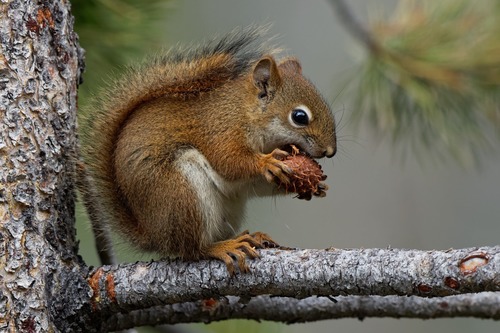
American Red Squirrel
Tamiasciurus hudsonicus
Small, vocal, and fiercely territorial, the American Red Squirrel is the 'chickaree' of the forest. Identifiable by their fiery coats and white eye rings, these energetic mammals are a constant source of entertainment for backyard observers.
Quick Identification
Size
Length: 28–35 cm (11–14 in); Weight: 200–250 g (7.1–8.8 oz)
Colors
Reddish-brown to olive-gray upper coat with a distinct white or cream-colored belly; often features a dark lateral stripe along the sides in summer.
Key Features
- Prominent white eye rings
- Small size compared to gray squirrels
- Bushy tail with a mix of red, black, and white-tipped hairs
- Bold, chattering vocalizations
When You’ll See Them
Sightings on EverydayEarth
May 13, 2026
A male Rose-breasted Grosbeak perches on the feeder tray, cracking open sunflower seeds. It departs suddenly just before an American Red Squirrel leaps onto the feeder to begin foraging in the same spot.
Jul 30, 2026
A small American Red Squirrel is seen moving through the debris and pine needles in the background of the large stick nest, investigating the area during the night.
Jul 30, 2026
Under the cover of night, an American Red Squirrel is seen exploring the upper rim of the large stick nest, moving cautiously along the branches.
Jul 29, 2026
A small American Red Squirrel is active during the night, scurrying across the back of the large stick nest. It moves quickly among the branches and pauses briefly before continuing out of view.
Jul 29, 2026
A small squirrel is seen exploring the interior of a large stick nest during the night. It moves cautiously across the branches, pausing to sniff the nesting material before climbing toward the background trees.
Jul 27, 2026
An American Red Squirrel hops into the center of the clearing from the left side of the frame. It pauses briefly to investigate the ground before scurrying off toward the background and disappearing into the brush near the tree line.
Geographic range
Where Does the American Red Squirrel Live?
The American Red Squirrel is a native fixture of the North American landscape, stretching from the northern treeline in Alaska and across the vast boreal forests of Canada. Within the United States, their core range extends through the Rocky Mountains, the Great Lakes region, and the Northeast down into the Appalachian Mountains. While they are absent from the central plains and the deep south, they are incredibly common wherever spruce, fir, and pine trees provide a steady supply of cones.
Basemap © OpenStreetMap contributors
Recorded on EverydayEarth
Behavior
The American Red Squirrel is a highly territorial and solitary mammal, known for its fiery personality and loud, scolding calls. Unlike many other squirrel species, they defend an exclusive year-round territory that centers around their food cache. They are most famous for creating 'middens'—large piles of discarded cone scales and stored seeds that can be used for generations and often reach several feet in height.
These squirrels are strictly diurnal, meaning they are active throughout the daylight hours. They are incredibly agile climbers and spend much of their time in the canopy, though they frequently descend to the ground to forage or bury seeds. In suburban environments, they are bold and curious, often dominating bird feeders despite their small size, and frequently engaging in high-speed chases with intruders.
EverydayEarth exclusive
Camera Tips
To capture the best footage of an American Red Squirrel, place your camera approximately 2 to 3 feet off the ground. These squirrels are habitual travelers, so look for 'highways' like fence rails, fallen logs, or low-hanging branches near evergreen trees. Mounting the camera directly onto a tree trunk facing a nearby feeding station or a known midden will guarantee frequent triggers.
Because Red Squirrels are incredibly fast and twitchy, use a camera with a fast trigger speed (0.3 seconds or less) and a high frame rate for video. Set your photo burst mode to take 3-5 images per trigger to increase the chances of catching them between their sudden, erratic movements. If your camera allows for it, a wide-angle lens is better than a telephoto because they tend to get very close to the lens out of curiosity.
Baiting is highly effective for this species. A smear of peanut butter on a tree trunk or a handful of black oil sunflower seeds and walnuts will keep them in the frame long enough for a clear shot. During the winter, they are especially active at feeders when other food sources are buried under snow. Positioning your camera near a source of water, like a birdbath, is also an excellent strategy during the hot summer months when they need to hydrate between foraging bouts.
Similar Species
Species that look similar or are commonly confused with American Red Squirrel.
Frequently Asked Questions
Record American Red Squirrel at your habitat
Connect a camera to start building your own species record — AI identifies every visitor automatically.