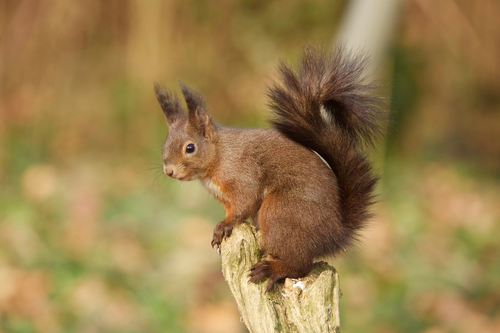
Eurasian Red Squirrel
Sciurus vulgaris
With its iconic winter ear tufts and bushy tail, the Eurasian Red Squirrel is the undisputed acrobat of the European canopy. This charismatic climber brings a flash of ginger energy to any backyard or woodland trail.
Quick Identification
Size
Body length 19–23 cm (7.5–9 in), tail 15–20 cm (6–8 in); weight 250–340 g (9–12 oz)
Colors
Variable coat ranging from bright ginger and reddish-orange to dark chestnut or black; always features a creamy white underside.
Key Features
- Prominent ear tufts, especially visible in winter
- Bushy, plume-like tail often as long as the body
- Sharp, curved claws for expert climbing
- Pure white underbelly contrasting with darker upper fur
When You’ll See Them
Geographic range
Where Does the Eurasian Red Squirrel Live?
The Eurasian Red Squirrel claims a vast native territory that stretches across the Palearctic region, beginning in the west from Ireland and the United Kingdom and extending across the entirety of Europe and Northern Asia to the Pacific coasts of Russia and Japan. While they are a common sight throughout the forests of Scandinavia and Siberia, their populations in parts of Western Europe, particularly the UK and Italy, have become increasingly fragmented. Despite these localized pressures, they remain one of the most widely distributed squirrel species in the world, adapted to everything from Mediterranean shrublands to the frigid northern taiga.
Basemap © OpenStreetMap contributors
Behavior
Eurasian Red Squirrels are highly active, arboreal mammals known for their incredible agility in the forest canopy. Unlike some other rodents, they do not hibernate; instead, they remain active year-round, though they may stay in their nests (called dreys) for several days during particularly harsh winter weather. They are 'scatter hoarders,' meaning they bury individual nuts or seeds in shallow holes across their territory to provide a food source during lean months.
While generally solitary and non-territorial, these squirrels live in overlapping home ranges and establish social hierarchies based on age and size. They are most active during the daylight hours, with peaks in the early morning and late afternoon. In areas where they are not persecuted, they can become quite bold around humans, frequently visiting garden bird feeders and showing a curious, though cautious, temperament.
EverydayEarth exclusive
Camera Tips
To capture the best footage of a Eurasian Red Squirrel, position your camera 1.5 to 2 meters (5-6 feet) high on a tree trunk or a dedicated feeding post. These squirrels are most comfortable off the ground, so angling your camera slightly downward from a neighboring branch or trunk can provide a great 'eye-level' perspective of their climbing behavior. Ensure the camera is facing away from the direct morning sun to avoid overexposed images during their peak activity hours.
Using a lure is highly effective for this species. A specialized squirrel feeder filled with hazelnuts, walnuts, or sunflower seeds will keep them stationary long enough for clear photos. If you are using a trail camera in a more natural setting, look for 'feeding tables'—flat-topped stumps littered with stripped pine cones—as these are favorite recurring spots for squirrels to process their food.
Because squirrels are incredibly fast movers, set your camera to a 'Burst' or 'Multi-shot' mode with at least 3 photos per trigger. Use a high shutter speed if your camera allows it, or ensure the area is well-lit to prevent motion blur. If your camera has a video mode, 10-20 second clips are ideal for capturing their twitchy, energetic tail signals and grooming habits.
Seasonality matters for your shots. During autumn, they are most active on the ground as they bury nuts, providing a rare chance for low-angle shots. In winter, their iconic ear tufts are at their longest and most photogenic, making this the best time for close-up portraits. If you are in a region where Grey Squirrels are also present, focus your camera on higher, thinner branches where the lighter Red Squirrel is more likely to venture compared to its heavier cousin.
Similar Species
Species that look similar or are commonly confused with Eurasian Red Squirrel.
Frequently Asked Questions
Record Eurasian Red Squirrel at your habitat
Connect a camera to start building your own species record — AI identifies every visitor automatically.