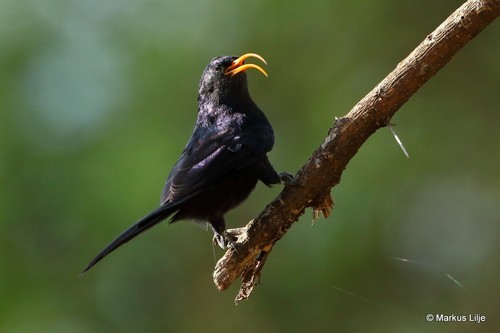
Abyssinian Scimitarbill
Rhinopomastus minor
With its striking scimitar-shaped orange bill and iridescent midnight plumage, the Abyssinian Scimitarbill is a master of the East African acacia forests. This elegant specialist spends its day performing surgical extractions of insects from tree bark, offering a fascinating look at savanna adaptation.
Quick Identification
Size
Length of 20–25 cm (8–10 in); Wingspan approximately 28–32 cm (11–13 in); Weight 25–36 g (0.9–1.3 oz)
Colors
Glossy blue-black or purplish-black plumage; distinctive bright orange-yellow decurved bill; white patches on wings and tail visible during flight
Key Features
- Slender, down-curved orange-yellow bill
- Glossy dark purple to black plumage
- White wing bars visible in flight
- Long, narrow tail with white spots
When You’ll See Them
Geographic range
Where Does the Abyssinian Scimitarbill Live?
Native to the arid regions of East Africa and the Horn of Africa, the Abyssinian Scimitarbill is commonly found across Djibouti, Ethiopia, Somalia, and Kenya. Its range extends into the dry bushlands of northern Tanzania, South Sudan, and Uganda. It is a strictly resident species, meaning it stays within these native territories throughout the year without migrating.
Basemap © OpenStreetMap contributors
Behavior
The Abyssinian Scimitarbill is a specialized forager, often observed creeping along the trunks and branches of acacia trees in a manner similar to a woodpecker or a treecreeper. Unlike their larger, more boisterous wood-hoopoe relatives, they are typically found alone or in pairs and maintain a much quieter, more solitary profile in the bush. They are diurnal and spend the majority of their day using their unique bills to probe deep into the fissures of tree bark.
While they are occasionally seen on the ground (terrestrial) searching for fallen insects, they are primarily arboreal. They are non-migratory residents that defend their territory year-round. Interestingly, their nesting sites in tree cavities are sometimes targeted by the Greater Honeyguide, a brood parasite, though the scimitarbill's focused foraging behavior remains largely unaffected by these interactions.
EverydayEarth exclusive
Camera Tips
To capture high-quality footage of the Abyssinian Scimitarbill, focus your AI-powered camera on vertical surfaces rather than the ground. These birds are specialized bark-probers, so mounting your camera on the trunk of a mature acacia or thorn tree—specifically one with deep fissures or loose bark—is the most effective strategy. Set the camera at a height of about 1.5 meters (5 feet) and angle it slightly upward to catch the bird as it spirals up the trunk.
Because they are attracted to the insects living within deadwood, placing a 'camera log' (a piece of rotting wood or a stump) within the field of view can be a great lure. Avoid using traditional seed or grain baits, as they will not attract this insect-eating specialist. Instead, maintaining a natural, pesticide-free garden with plenty of native woody plants will ensure their prey remains abundant.
Since they are active during the brightest parts of the day, ensure your camera is positioned to avoid direct lens flare from the intense African sun. A high shutter speed or a burst mode is recommended, as their movements while extracting larvae are quick and jerky. If you have an AI-powered camera, set it to trigger on 'Small Birds' and look for the distinctive orange flash of the bill to confirm a successful sighting.
Similar Species
Species that look similar or are commonly confused with Abyssinian Scimitarbill.
Frequently Asked Questions
Record Abyssinian Scimitarbill at your habitat
Connect a camera to start building your own species record — AI identifies every visitor automatically.