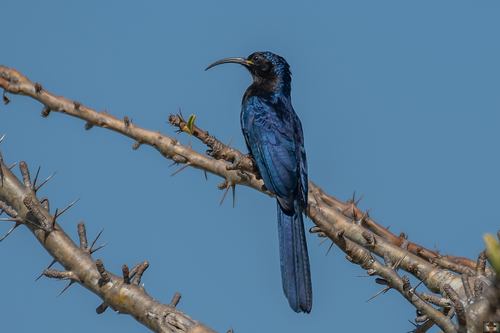
Common Scimitarbill
Rhinopomastus cyanomelas
With its signature sickle-shaped bill and shimmering midnight plumage, the Common Scimitarbill is the acrobat of the African savanna. This striking bird is a master of the bark, spending its days performing gravity-defying maneuvers to find hidden treats.
Quick Identification
Size
26–30 cm (10–12 inches) in length; weight typically between 24–38g (0.8–1.3 oz)
Colors
Glossy black with a deep purple or violet iridescence; white bars on wings and white tips on the outer tail feathers; females and juveniles are slightly duller with brownish-grey throats.
Key Features
- Long, slender, and deeply downward-curved black bill
- Iridescent blue-black plumage with white wing patches visible in flight
- Highly acrobatic, often seen hanging upside down on bark
- Long, graduated tail with distinct white spotting on the edges
When You’ll See Them
Geographic range
Where Does the Common Scimitarbill Live?
The Common Scimitarbill is a quintessential African species, occupying a vast range across the southern and eastern parts of the continent. It is found reliably from the Cape in South Africa northward through the arid landscapes of Namibia, Botswana, and Zimbabwe, stretching into the tropical savannas of East Africa including Kenya, Tanzania, and Somalia. While it is a resident species across most of its territory, its presence is most concentrated in undisturbed acacia-dominated woodlands and riverine forests.
Basemap © OpenStreetMap contributors
Behavior
The Common Scimitarbill is a master of arboreal acrobatics, spending much of its day hitching along tree trunks and branches in search of food. Unlike their social relatives, the wood-hoopoes, scimitarbills are typically seen alone or in mated pairs. They possess a remarkable ability to probe into the narrowest crevices of bark, using their specialized bills to extract larvae and insects that other birds cannot reach.
These birds are restless and energetic, frequently fluttering from tree to tree with a distinctive, jerky flight pattern. While they can be somewhat shy around humans, they are highly vocal, often giving away their presence with a series of mournful, whistling 'poo-poo-poo' calls. They are strictly territorial and will actively defend their nesting holes—usually repurposed woodpecker or barbet cavities—from intruders during the breeding season.
EverydayEarth exclusive
Camera Tips
To capture a Common Scimitarbill on camera, focus your efforts on vertical structures rather than the ground. These birds are bark-feeders, so mount your AI-powered camera 1.5 to 2.5 metres high on the trunk of a rough-barked tree, such as an Acacia or a Combretum. Angle the camera slightly upward to capture them as they hitch their way up the trunk. Because they move quickly and erratically, use a fast shutter speed or a 'burst' mode if your camera settings allow.
While they don't typically visit traditional bird feeders, they are highly attracted to water in arid environments. Placing a camera near a birdbath or a dripping water feature can yield excellent results, especially during the heat of the midday. Ensure the camera is positioned to capture the bird's profile to highlight the dramatic curve of the bill, which is their most striking feature.
Pay attention to the lighting; their iridescent feathers can appear flat and black in dull light but shimmer with vibrant purples and blues in direct sunlight. Position your camera facing north (in the Southern Hemisphere) to get the best light on the bird's plumage during the morning and afternoon peaks. If you have a 'tree-mount' accessory, use it to get the camera off the ground where these birds feel most comfortable.
Similar Species
Species that look similar or are commonly confused with Common Scimitarbill.
Frequently Asked Questions
Record Common Scimitarbill at your habitat
Connect a camera to start building your own species record — AI identifies every visitor automatically.