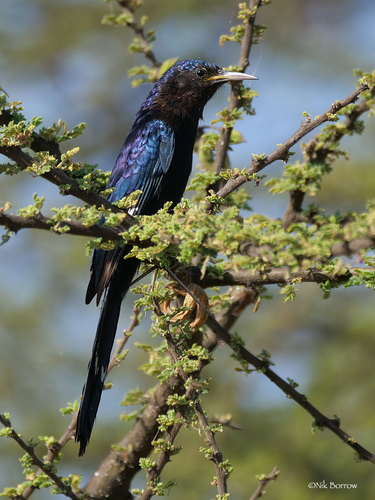
Black Scimitarbill
Rhinopomastus aterrimus
The Black Scimitarbill is a sleek, acrobatic specialist of the African savannah, known for its distinctively curved bill and glossy, midnight plumage. Watch as it dances across tree trunks with surgical precision, uncovering the hidden world of the woodland canopy.
Quick Identification
Size
23-27 cm (9-11 inches) in length; weight approximately 20-35 grams (0.7-1.2 oz)
Colors
Uniformly glossy black plumage with a subtle bluish or purplish sheen; bill and legs are charcoal black
Key Features
- Slender, moderately downward-curved black bill
- Glossy blue-black plumage across the entire body
- Relatively short, square-ended tail
- Small white patches on the wings visible during flight
When You’ll See Them
Geographic range
Where Does the Black Scimitarbill Live?
The Black Scimitarbill is a native of the African continent, occupying a wide horizontal belt across the sub-Saharan region. It is most commonly found in the Sahel and Sudanian savannahs, stretching from Senegal and Gambia in the west, through Nigeria and Chad, into Ethiopia and Kenya in the east. It also extends southward into parts of the Democratic Republic of the Congo and northern Angola, avoiding the densest rainforests in favor of more open, wooded landscapes.
Basemap © OpenStreetMap contributors
Behavior
The Black Scimitarbill is a master of acrobatic foraging, often seen clinging to the sides of tree trunks and the undersides of branches. Unlike its more gregarious cousins, the wood hoopoes, this species is typically solitary or found in pairs. It moves with a restless energy, hitching its way up bark and poking its curved bill into every available crevice to find hidden prey.
While they are not overly vocal, they do possess a range of whistling calls that can help a keen observer locate them in the canopy. They are territorial during the breeding season and will use old woodpecker or barbet holes for nesting. Unlike many other savannah birds, they are quite shy and tend to keep a distance from human activity, though they will occasionally venture into quiet, well-wooded gardens.
EverydayEarth exclusive
Camera Tips
To capture the Black Scimitarbill on camera, you must focus on their unique foraging behavior. These birds are "bark-creepers," so avoid placing your camera on the ground. Instead, mount your AI-powered camera at a height of 5 to 8 feet, directed at the trunk of a rough-barked tree or a major horizontal limb. This is where they spend the majority of their time probing for insects.
Because of their glossy black feathers, lighting is your biggest challenge. Direct midday sun can cause harsh highlights that wash out the bird's details, while deep shade can make them look like a lightless silhouette. Aim for a spot that receives bright, filtered light. If your camera allows for exposure adjustment, slightly underexposing can help preserve the iridescent blue sheen of their plumage.
While they don't typically visit standard seed feeders, they are highly attracted to water in dry environments. A birdbath or a dripping water feature placed near a wooded edge can be a powerful lure. Ensure your camera's trigger speed is set to its fastest setting; Scimitarbills move their heads rapidly when probing bark, and a slow trigger will result in motion blur.
Lastly, consider the background. Because the bird is entirely black, a busy or dark background will make it disappear. Try to position the camera so that the tree trunk they visit is offset against a lighter, out-of-focus background of distant foliage or the sky. This will help the AI recognition software identify the bird's unique scimitar-shaped silhouette more effectively.
Similar Species
Species that look similar or are commonly confused with Black Scimitarbill.
Frequently Asked Questions
Record Black Scimitarbill at your habitat
Connect a camera to start building your own species record — AI identifies every visitor automatically.