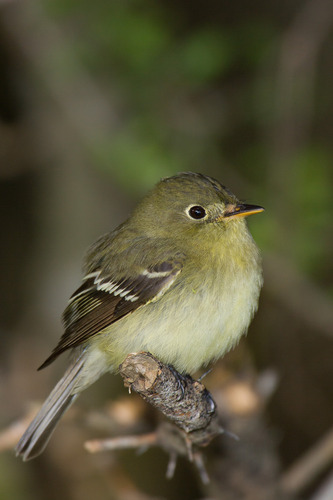
Acadian Flycatcher
Empidonax virescens
A hidden gem of the humid woods, the Acadian Flycatcher is a vibrant olive-green hunter that thrives near forest streams. While its plumage provides perfect camouflage, its explosive 'peet-sa' call and acrobatic flight make it a favorite for backyard birders with a keen ear.
Quick Identification
Size
Length: 13–15 cm (5.1–5.9 in), Wingspan: 23 cm (9 in), Weight: 11–14 g (0.39–0.49 oz)
Colors
Olive-green upperparts, pale yellowish to white underparts, dark wings with two prominent white bars, and a thin white eye-ring.
Key Features
- Sharp, explosive 'peet-sa' or 'tee-chup' call
- Two distinct white wing bars
- Relatively long, broad bill with a pale orange lower mandible
- Prominent white eye-ring and olive-green crown
When You’ll See Them
Geographic range
Where Does the Acadian Flycatcher Live?
Native to the Western Hemisphere, the Acadian Flycatcher is a long-distance traveler that bridges the gap between North and South America. During the spring and summer breeding months, its core range extends across the Eastern United States, reaching as far north as Southern Ontario and west to the edge of the Great Plains. As autumn approaches, these birds migrate through Mexico and Central America to spend their winter in the lush tropical forests of Panama, Colombia, Ecuador, and Venezuela.
Basemap © OpenStreetMap contributors
Behavior
The Acadian Flycatcher is a master of the forest understory, known for its upright posture while perched on low-hanging branches. Unlike many songbirds that forage actively through foliage, this species is a 'sit-and-wait' predator. It remains motionless for long periods before darting out in a sudden, acrobatic burst to snatch an insect mid-air or off the underside of a leaf, often returning to the same branch to consume its prize.
These birds are highly territorial during the breeding season and are more often heard than seen. Their sharp, sneezing call is a staple of humid eastern woodlands in the summer. While they generally avoid human interaction, they are not particularly shy and will continue their foraging loops even if a quiet observer is nearby, provided there is enough canopy cover to make them feel secure.
EverydayEarth exclusive
Camera Tips
To capture the Acadian Flycatcher on camera, your best bet is to focus on 'perch-hopping' zones near water. Look for horizontal, bare branches that hang over a stream or a shaded forest pool, typically at a height of 3 to 10 feet. This species often returns to the same favorite hunting perches, making them predictable subjects for stationary trail cameras. Angle your camera slightly upward if the branch is high, or level with the perch to capture their distinct upright profile.
Because these birds are incredibly fast when 'sallying' for insects, you must use a camera with a high trigger speed (0.2 seconds or less) and a high-speed burst mode. If your camera supports it, set it to record 10-second video clips in high definition. The subtle olive-green plumage can easily blend into the forest background, so try to position the camera so the perch is backlit by a small gap in the canopy, which helps define the bird's silhouette.
While they won't visit traditional bird feeders, you can attract them to your camera's field of view by installing a solar-powered water mister or a dripping birdbath. The sound of moving water is an irresistible lure for flycatchers in the heat of summer. Ensure the area is well-shaded, as they rarely venture into bright, open sunlight. In suburban backyards, placing a camera near a damp, wooded corner with dense overhanging trees is the most likely way to find them during their migration.
Similar Species
Species that look similar or are commonly confused with Acadian Flycatcher.
Frequently Asked Questions
Record Acadian Flycatcher at your habitat
Connect a camera to start building your own species record — AI identifies every visitor automatically.