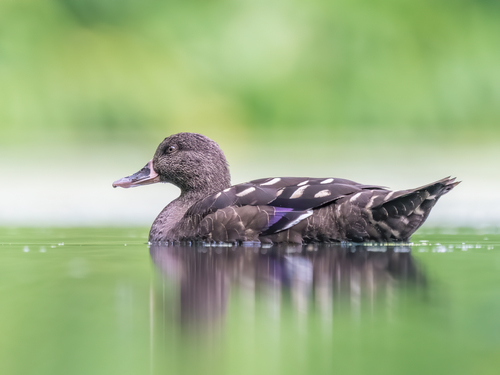
African Black Duck
Anas sparsa
The African Black Duck is the elegant, dark-plumed sentinel of Africa's waterways. Unlike its boisterous relatives, this shy resident prefers the solitude of wooded streams and quiet garden ponds.
Quick Identification
Size
Length 48-57 cm (19-22 inches); wingspan 80-90 cm (31-35 inches); weight 800-1,100g (1.8-2.4 lbs).
Colors
Sooty-black to dark brown plumage with white transverse bars on the back and rump; iridescent green-blue speculum with white borders; yellow-orange legs.
Key Features
- Distinctive white blotches or bars on a dark back
- Bright orange or yellow legs and feet
- Dark grey bill with a black nail
- White-bordered green or blue wing patch (speculum)
When You’ll See Them
Sightings on EverydayEarth
Jun 8, 2026
An Egyptian Goose and an African Black Duck are observed in the shallow water of a river. The Egyptian Goose swims toward a small rock and stands up on its pink legs, while the African Black Duck remains floating closely beside it.
Geographic range
Where Does the African Black Duck Live?
The African Black Duck is native to the African continent, where it maintains a widespread but localized presence throughout sub-Saharan Africa. It is most commonly found in the eastern and southern regions, with strong populations in South Africa, Zimbabwe, Kenya, and Ethiopia. While it avoids the most arid desert regions, it is a hardy resident found everywhere from sea-level coastal rivers to high-altitude mountain streams in the Drakensberg and Ethiopian Highlands.
Basemap © OpenStreetMap contributors
Behavior
The African Black Duck is notably more territorial and solitary than most other members of the Anas genus. Unlike the highly social Mallard, these ducks are typically found in pairs or small family groups, fiercely guarding specific stretches of river or stream. They are quite shy and prone to retreating into overhanging vegetation at the first sign of a disturbance, making them a rewarding but challenging subject for backyard observers.
These ducks are primarily active during the crepuscular hours of dawn and dusk. During the day, they often loaf on mid-stream rocks or hidden banks. While they are capable flyers, they prefer to swim or dive when threatened. Their vocalizations are similar to a Mallard's quack but are generally quieter and more raspy, used primarily to maintain contact between pairs in thick riverine cover.
EverydayEarth exclusive
Camera Tips
To capture the African Black Duck on camera, placement is everything. These birds are river specialists, so aim your camera at flat rocks protruding from the water or low-lying muddy banks where they are likely to groom or rest. Because they are shy, use a camera with a fast trigger speed and a 'no-glow' infrared flash to avoid startling them during their peak activity periods at dawn and dusk.
Position your camera low to the ground—ideally 30-50 cm high—angled slightly upward to capture the intricate white barring on their backs. If you have a backyard pond or a stream on your property, focus on areas with overhanging branches or reeds, as these ducks feel safest when cover is nearby. They are creatures of habit and will often use the same 'loafing' spot daily.
While they don't respond well to traditional birdseed, you might find success near water features that are naturally rich in aquatic life. In suburban settings, they are occasionally attracted to fallen fruit or grain, but their primary draw is a clean, quiet water source. Ensure your PIR (motion) sensitivity is set to high, as ducks moving through water can sometimes fail to trigger sensors calibrated for larger mammals.
Similar Species
Species that look similar or are commonly confused with African Black Duck.
Frequently Asked Questions
Record African Black Duck at your habitat
Connect a camera to start building your own species record — AI identifies every visitor automatically.